
Essential Structural Elements
Door Panels and Their Materials
Panel selection determines how a folding door feels and endures. In the broader world of folding doors parts, the door panels carry the most stress during daily operation. A well built panel resists warping, absorbs impact, and maintains a tight seal.
Common materials include laminated timber, extruded aluminium, and tempered glass. Each suits different climates and usage patterns. For coastal South African homes, aluminium panels resist corrosion better than steel hinges or tracks. Timber offers natural insulation but demands periodic sealing. Glass panels open up light, yet require careful handling.
To simplify choices, consider these traits!
- Timber: strong, warm, but needs maintenance
- Aluminium: lightweight, rust resistant
- Glass: transparent, adds elegance
A panel’s core affects thermal performance. Honeycomb cores reduce weight, while foam cores improve insulation. These structural elements quietly define the entire folding doors parts system.
Top and Bottom Guides
A folding door’s graceful glide is an illusion of effortlessness, masking the hard work of its unseen anatomy. The top and bottom guides are the unsung heroes, the quiet choreographers of every smooth operation. Ignore them, and you invite a world of grinding resistance and premature wear. These are the track components that manage weight distribution and maintain vertical alignment, ensuring the panels roll true.
Bottom guides bear the full brunt of the load, often facing the gritty realities of dust and debris. This is where precision matters most. The track must be level and securely anchored to prevent wheels from binding. The component profiles are designed to be forgiving, yet they demand correct installation. Meanwhile, the top guides act as the stabiliser, preventing the panels from swinging and swaying as they move.
– Bottom rollers take the weight and dictate the smoothness of the roll.
– Top guides keep the panels aligned and prevent derailment.
– End stops provide a secure and cushioned finish to the travel path.
For a coastal climate in South Africa, the materials of these guides are non-negotiable. A stainless steel or anodised aluminium track will survive the salt-laden air far longer than a galvanised alternative. This is an area where cutting corners on quality leads to a compromise in the entire folding doors parts system. The result is a system that feels heavy and laboured. The right guides will keep your door moving with the stability it was designed for.
Pivot Brackets and End Posts
Every folding door reaches a point where the entire load funnels into a single fulcrum. The pivot bracket is that point, and among all folding doors parts, it is the one most likely to be under-specified. It transfers the door’s mass to the floor and anchors the rotation. In South Africa’s coastal climate, this component must absorb forces that would distort lesser hardware.
End posts complete the structural frame as the terminal anchor holding the assembly taut. A rigid end post prevents panels from sagging, while the pivot bracket allows controlled swinging.
- Pivot brackets carry the vertical load at each hinge point
- End posts hold the assembly taut and aligned
For a complete folding doors parts system to perform in South African conditions, these structural elements require marine-grade materials and precise installation. I have seen doors fail in under five years because this hardware was under-specified.
Hinges and Pivot Hardware
Pivot Hinges
Every time you fold a door, the pivot hinge bears the load. It is a single point of contact that must endure thousands of cycles without sagging. In South African homes, where wide aluminium and timber panels are common, this hardware often works harder than you expect!
The pivot hinge differs from a standard butt hinge because it allows the panel to rotate from its top and bottom corners. This distribution reduces stress on the frame. Key features include:
- Adjustable pins for fine alignment
- Nylon bearings that reduce friction
- Stainless steel construction to resist rust
These components are essential in folding doors parts. A well designed pivot hinge keeps the door moving smoothly even after years of use. For anyone repairing or upgrading a system, the choice of pivot hardware determines the longevity of the entire door.
Center Hinges
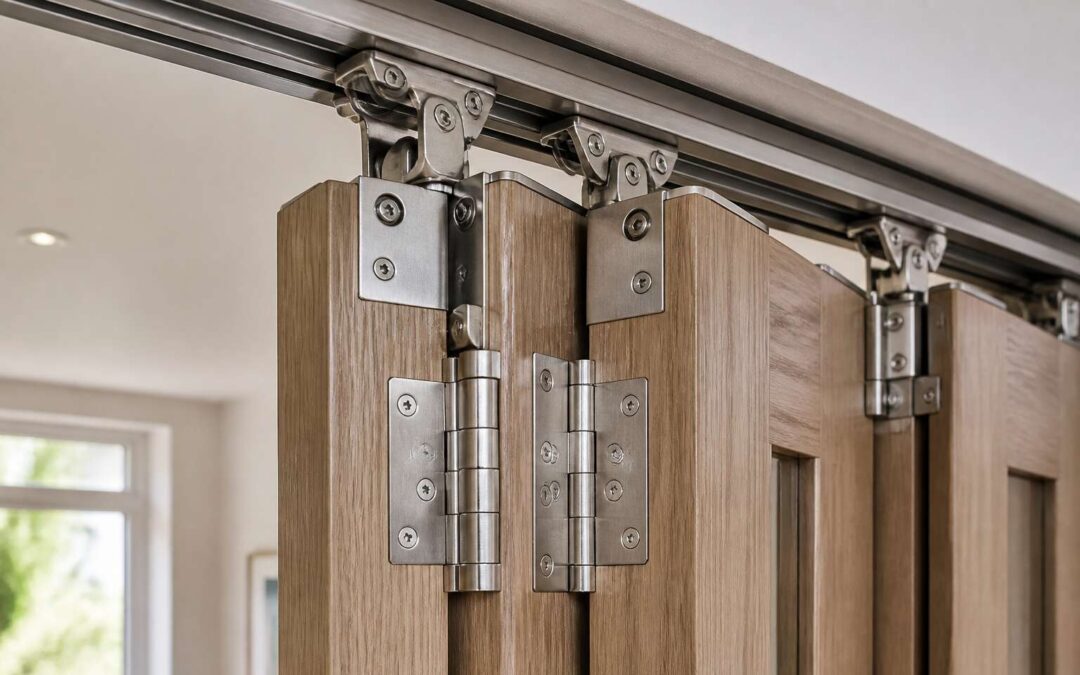
Center hinges are the middle children of folding doors parts. They don’t get the glory of pivot hardware, but without them, your door would fold like a confused giraffe. These hinges sit between panels, allowing each section to articulate without binding. In South Africa, where wind can treat a door like a kite, a robust centre hinge is non-negotiable. Look for:
- Double bearing joints for even load spread
- Corrosion resistant coatings for coastal air
- Precision pins to avoid gap misalignment
A quality centre hinge prevents your panels from fighting each other. It keeps the fold tight, the motion fluid, and the frame stress minimal. While pivot hinges handle the corners, centre hinges manage the chaos in between. Choosing the right one means fewer creaks, fewer sagging panels, and a door that actually behaves.
End Hinges
The outermost panel of a folding door transfers its entire load through the end hinge, where the door meets the fixed jamb or pivot post. These folding doors parts carry the full weight of the collapsed stack and pass every gust of wind into the frame.
South African coastal winds wear down weak hinges quickly. We have watched standard hinges lift within two seasons on a Cape Town patio. A well made hinge uses cast stainless steel and a broad mounting plate, spreading the load across the jamb instead of two small screws.
Quality end hinges share these traits:
- Stainless steel or zinc alloy bodies for corrosion resistance
- Wide mounting plates that distribute load across the jamb
- Three axis adjustment screws to correct alignment after settling
Among folding doors parts, the end hinge endures the largest strain. Undersized hardware causes sagging panels, drifting gaps, and doors that never close squarely.
Replacement Hinge Pins
Every folding door hides a silent failure in its hinge pins. These small rods endure constant torsion and salt air, especially in coastal towns like Cape Town. When they bend or corrode, the panels sag and scrape.
Replacement hinge pins are among the most overlooked folding doors parts, yet they restore the door’s movement quietly.
Watch for these signs:
- Scraping sounds when panels fold
- Visible rust streaks near hinges
- Panel gaps that widen at the bottom
Replacing a pin takes minutes, but choose grade stainless steel. Ordinary steel pins will fail again within seasons. Measure the pin’s diameter and length carefully; folding doors parts vary between manufacturers. A worn pin can also damage the hinge barrel, turning a cheap fix into a costly repair. Your folding door will close straight again when the pin is replaced promptly.
Rollers, Tracks, and Trolley Systems
Top Rollers
Consider the quiet anatomy of a folding door. Above the visual clamour of panels and hinges, the entire operation depends on the top rollers, tracks, and trolley systems. These are the mechanical sinews that carry the weight. When you source folding doors parts, remember that the top roller assembly is responsible for the smooth, lateral glide you feel when the door opens, not the hinges. Poorly matched rollers can cause a distinct catch or a gritty resistance that signals premature wear.
For a door to function correctly, the trolley system must house sealed ball bearings. The wheel material matters as much as the bearing itself. Nylon wheels are quiet and gentle on the track, while steel wheels offer superior durability on heavier systems. Here is what the top roller must do:
– Carry the door’s load without distortion.
– Maintain alignment within the track channel.
– Allow for vertical adjustment to level the panels.
The track and trolley interface needs periodic inspection. Over time, dust and grit accumulate on the track surface. This acts as an abrasive compound, increasing friction and wearing down the wheels. A proper trolley system includes a guide that keeps the roller centred. This prevents the panel from swaying or binding as it travels.
A galvanised track with a precise profile ensures a consistent contact patch. When you inspect your existing setup, check for lateral play in the trolley. That play indicates worn bearings or a bent axle. In coastal climates like Durban, corrosion is the enemy. Stainless steel axles and plated brackets resist the salt air far better than standard hardware. Ensure your replacement folding doors parts match the original track gauge and trolley spacing to avoid stress on the end posts.
Bottom Rollers
While the top rollers bear the gravitational load, the bottom roller functions as a critical stabilizer. It does not carry the door’s weight, but it manages the arc of the swing and prevents the panel from drifting out of its vertical plane. In many systems, this component is a simple peg that slides within a floor track. In others, it is a wheeled carriage that negotiates a recessed channel. The distinction matters when you order replacement folding doors parts, as the floor profile determines which style you require.
– A bottom guide pin works with a shallow aluminium floor track.
– A wheeled bottom roller suits heavier timber doors where the panel needs to be lifted slightly to clear the threshold.
– A nylon glider is ideal for internal applications where carpet or timber flooring demands minimal disruption.
The interaction between the bottom roller and its track is a point of friction that often goes unnoticed until it fails. If your door drags across the floor or produces a hollow scraping sound, the culprit is usually a worn glider or a track clogged with compacted debris. Unlike the top trolley, which requires alignment and bearing checks, the bottom roller demands a simple inspection for groove wear. A split or flattened wheel creates lateral thrust that can skew the entire panel stack. In coastal regions, the aluminium track can oxidise, creating a chalky residue that increases resistance. Matching the correct roller diameter to your existing track width is essential, as an undersized wheel will allow the door to rattle against the floor guide. The quiet operation of a folding door hinges on these unglamorous base components, which maintain the panel’s true path and protect the hinges from undue twisting force.
Track Channels
A folding door’s silent precision depends on components few homeowners ever see. The track channel, typically extruded from aluminium or powder-coated steel, defines the entire trajectory of the panel stack. Trolleys ride inside this channel, their bearings engineered for consistent vertical load distribution. When ordering folding doors parts, examine the channel’s internal profile carefully. A C-shaped channel suits lighter domestic doors, while an H-shaped profile offers lateral rigidity for wider commercial spans.
- Nylon rollers minimise friction in dry interior conditions.
- Steel rollers withstand the repetitive stress of heavy timber panels.
- Precision ball bearings keep the trolley moving smoothly for decades.
The trolley system’s interaction with the channel surface determines long-term wear. A misaligned track creates uneven pressure, causing the carriage to bind at specific points. Routine inspection of the channel interior, clear of debris and corrosion, preserves the trolley’s freedom of movement.
Trolley Assemblies
A trolley assembly carries the folding door load on a single pivot pin. That pin takes the full shearing load every time a panel folds, and when it wears, the whole stack develops a subtle shiver you can feel before you see it! I have seen carriages fail because the plate was stamped from thin steel that flexed under constant tension.
The carriage plate is the most underrated component:
- Cast aluminium plates stay true in dry Highveld conditions.
- Pressed steel plates resist twisting but invite corrosion near the coast.
- Galvanised plates offer a compromise for coastal installations.
Roller spacing determines how the stack behaves under wind load. Wide spacing keeps panels stable in open patios. Narrow spacing suits internal room dividers. When I source folding doors parts, I inspect the carriage’s bearing seat and pivot pin. Folding doors parts fail at the pivot point more often than at the rollers.
Track Stops and Floor Guides
A track stop is the quiet guardian at the end of a run. It catches the trolley before momentum carries a panel past the opening. Floor guides work below sight lines. They hold the bottom pivot in a gentle groove, so the door does not sway when the wind off the Karoo finds a gap.
I often tell clients that these small folding doors parts are the difference between a door that glides and one that argues. A nylon stop absorbs contact without chatter. A steel stop survives years of harsh use. Floor guides come in two common forms: surface mounted and recessed. Surface guides suit existing patios; recessed guides sit flush with screed for a clean interior transition.
For coastal homes, choose guides with sealed bearings. Salt air attacks exposed metal faster than any movement does. When sourcing folding doors parts, inspect the stop’s mounting screws and the guide’s channel depth. A shallow channel gives the door room to wobble, while a deep one locks the panel like a hand in a glove.
Operational Hardware and Security
Handles and Pulls
Crime statistics in South Africa consistently show that residential entry points are the primary target for opportunistic intruders. The operational hardware on your folding doors parts determines how smoothly the system moves and how effectively it resists tampering.
Security handles typically incorporate a locking mechanism that engages multiple points along the door leaf. This distributes clamping force and prevents the leaf from being lifted or prised from its track. For harsh coastal or Highveld conditions, a robust handle assembly with a zinc alloy core offers the best balance between longevity and protection.
Pulls serve a purely ergonomic function. A good design sits flush enough to avoid snagging curtains, yet protrudes enough for a comfortable grip. Common configurations:
- Recessed pulls
- T-bar handles
- Pad handles
The interaction between these components and the rest of your folding doors parts is often underestimated.
Locks and Latches
The quiet click of a mortise lock signals a secure closure in any folding door system. In South Africa, where perimeter security is paramount, the lock and latch assembly functions as the primary barrier. These folding doors parts work silently, yet their presence determines whether an intruder finds resistance or invitation.
Hardware configuration follows the leaf’s construction:
- Mortise locks suit timber leaves
- Surface-mounted latches fit aluminium frames
- Shoot bolt systems engage head and sill simultaneously
The lock cylinder must resist picking and bumping, and the strike plate requires hardened screws that bite deep into the frame. A latch must align precisely with its strike plate. Misalignment creates wear, and wear creates weakness. I have seen too many fine installations compromised by a single millimetre of drift!
Strike Plates
Operational hardware controls how every folding door leaf moves along its track. The alignment of these components determines the effort required to open and close the door. In South Africa, consistent daily use and fluctuating temperatures demand that this hardware remains precisely adjusted. A single loose bolt or worn bearing creates uneven wear across the entire system.
Security strike plates provide the final defensive layer for the locking mechanism. Standard latch plates offer minimal resistance, but a security strike plate extends deep into the frame and distributes force across multiple anchor points. To withstand deliberate force, the strike plate must be manufactured from hardened steel and fixed with screws that penetrate the structural timber or aluminium.
- Material thickness of at least 3mm
- Staggered screw holes to prevent splitting
- A deep box section that fully encloses the latch
- Fixing screws of 40mm or longer
These folding doors parts operate as a cohesive unit, yet the strike plate carries the load when someone tests the lock. The right selection of this component transforms a simple latch point into a fortified barrier.
Soft-Close Mechanisms
The difference between a gentle sigh and a violent slam is a 20-millimetre hydraulic cylinder. A security soft-close mechanism works with operational hardware to control the final approach of each folding door leaf. It converts kinetic energy into smooth resistance, preventing the jarring impact that loosens fasteners and misaligns tracks over time.
In South Africa, where heatwaves and cold snaps alter material tolerances, this damping system demands attention. The adjustment screw regulates the bypass valve, and a quarter turn can change the closing speed dramatically!
- a damper rated for the leaf mass
- a piston rod sealed against humidity
- a bypass valve with a durable adjustment screw
These folding doors parts need to work as one, or the soft-close feature becomes a liability.
Protective and Sealing Components
Weatherstripping
Nearly forty percent of a building’s thermal energy escapes through the perimeter gaps of its openings. This stat is why weatherstripping is the unsung hero of your installation. It is the flexible barrier that seals the space between the door panel and the frame, preventing dust, moisture, and cold drafts from entering your living space.
Weatherstripping on folding doors parts is often made from EPDM rubber or silicone. These materials remain pliable in harsh South African sun and resist cracking. The installation location matters. You will find it on the bottom edge of panels to block floor gaps, but it also lines the vertical meeting stiles where panels fold.
The performance of your door depends on this component. When the seal compresses correctly, it reduces noise and keeps out insects. Look for these common options:
- Magnetic strips for a tight seal with metal frames
- Bulb-shaped gaskets that compress easily
- Brush seals for sliding motion over uneven surfaces
Quality sealing elements must move with the panel without binding. A worn or hardened gasket is a common culprit behind drafts and rattling. When you service your folding mechanisms, inspect these strips for wear. Replacing them is inexpensive and restores the efficiency of your entire system.
Bottom Seals
Bottom seals take a beating that other folding doors parts simply do not. While weatherstripping blocks drafts, this component shields the door from water, mud, and the fine red dust that finds its way into every South African home. After a summer thunderstorm, you will know exactly how well your bottom seal performed.
Most bottom seals combine an aluminium housing with a rubber or brush insert. The aluminium protects the door panel while the insert presses against the floor threshold. When the seal fails, the symptoms are obvious. Damp carpets, swollen door panels, and rusted track hardware all point to the culprit.
Check your bottom seals for:
- Bowed or cracked aluminium tracks
- Brittle rubber inserts that have lost their flexibility
- Broken end caps that let water pour through
Replacing a worn bottom seal costs very little. It is one of the cheapest folding doors parts you will ever buy. A replacement with dual rubber lips directs water away from the track channel, preserving the rest of your hardware.
Draft Excluders
Draft excluders serve a quieter purpose than their heavier counterparts. They sit along the vertical edges and top of the folding door, sealing the gaps between panels and the frame. While bottom seals manage water and mud, draft excluders stop the wind that whistles through narrow openings. In South African homes, they keep out the cold Highveld air in winter and the dust of the Karoo in summer.
These components usually take the form of flexible brush strips or rubber fins set into aluminium carriers. Over time, the bristles flatten and the rubber loses its shape. Check for:
- Gaps visible between the closed panels
- Bristles that no longer spring back
- Cracked carriers that leave the seal unsupported
Replacing a worn draft excluder is a simple job. It is one of the most affordable folding doors parts you can source, yet it protects the entire door system from constant airflow and debris. Properly maintained, these folding doors parts keep the whole structure stable for years.
Glazing Beads
While draft excluders tame the edges, glazing beads defend the glass itself. These slender strips sit inside the panel frame and hold each pane under tension. Without them, the glass rattles loose, moisture sneaks into the frame, and the entire panel integrity begins to fail.
South African sunlight ages these components fast. I have seen beads crumble after just five summers. UV radiation turns pliable rubber into brittle plastic, and one storm with flying debris finishes the job.
When inspecting your folding doors parts, check for:
- Hairline cracks running the length of the bead
- Sections pulled away from the frame
- A bead that no longer sits flush against the glass
Replacing worn glazing beads is a small job, but it protects the entire panel assembly. These folding doors parts cost very little compared to a shattered pane. Yet most homeowners only notice them when the glass begins to shift.
Troubleshooting and Replacement Tips
Identifying Worn Rollers
When a folding door starts to scrape and hesitate, the roller assembly often holds the answer. Worn rollers reveal themselves through subtle signs: uneven travel, a persistent tilt, or a faint grinding noise that grows with each use.
For anyone maintaining folding doors parts in homes or offices, checking the wheel’s surface for flat spots is the first step. These deformations occur after years of pressure against the track. Watch for these common indicators:
- Recurring friction at a specific point
- Visible wear patterns on the wheel’s rim
- Loose movement that worsens over time
Replacement demands matching the roller’s exact diameter and axle length, because worn components rarely fail in isolation.
Choosing Replacement Hinges
A hinge fails quietly. The worn barrel, the elongated screw hole, the subtle twist in the leaf all arrive long before the door protests aloud. When sourcing folding doors parts for a replacement hinge, measure the leaf width, the screw spacing, and the barrel diameter first. These dimensions determine whether the new component seats flush or introduces a persistent bind.
Troubleshooting begins with the sag test. Close the door, lift the free edge, and feel for play. Movement beyond a hair’s breadth signals a hinge that has lost its tolerance. In coastal South African homes, corrosion accelerates this decay, so I always inspect the hinge knuckles for pitting and discoloration. A hinge that cannot hold its alignment transfers strain to the guides and rollers, turning one failed part into a systemic problem.
Sourcing Compatible Components
Troubleshooting reveals whether the failure is isolated or systemic. When the sag spreads, inspecting every folding doors part becomes a ritual of mapping tolerances. The most common mistake appears during sourcing, when measurements are taken from worn components rather than the untouched side of the assembly. In South African coastal towns, salt-laden air changes expansion rates, so a guide that works perfectly in a Highveld home may bind here. I always carry a vernier gauge when visiting a job site for this reason.
What you need to verify before ordering replacements:
- Track profile squareness at the point of wear, not just the visible surface
- Trolley axle diameter against the existing wheel bore
- Floor guide clearance factored against the new threshold height
Once those dimensions are confirmed, ordering becomes a matter of patience rather than guesswork. A mismatched part, even by a half millimetre, transfers load back to the hinges and starts the failure cycle again. The quietest repair is the one that never requires a second adjustment.
Installing New Seals
A seal that fits in a dry workshop can still misbehave after twenty minutes in Cape Town’s humidity. When I install new seals for folding doors parts, I start by checking the extrusion groove for old adhesive residue. This step prevents the fresh seal from popping out within a week.
The trick is measuring compression before pressing home. A vernier caliper gives the exact thickness. Too thick for the channel, the seal bows at corners. Too thin, it whistles.
After seating the new seal, cycle the door twice. If the seal shifts, adjust the trolley alignment first. Re-seating the seal before correcting the trolley wastes time.
Proceed with these steps:
- Clean the groove with a nylon brush and isopropyl alcohol.
- Dry fit the seal at the corners before cutting.
- Lubricate the lip with silicone spray only after final seating.
Patience with these folding doors parts pays off every time!