
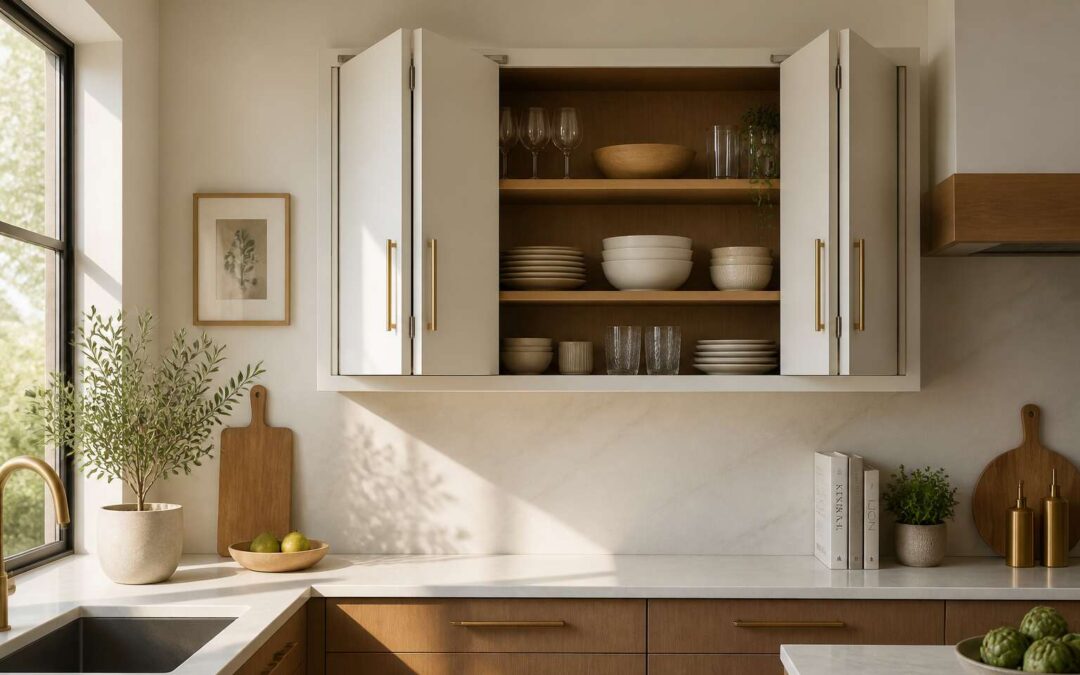
Maximizing Kitchen Space and Accessibility
How Bi-Fold Cabinet Doors Open Up Your Workflow
A recent survey by a major South African hardware retailer revealed that kitchen storage inefficiency is the primary driver of cabinet renovations in Johannesburg and Cape Town. The standard hinged door, with its sweeping arc and requirement for clear floor space, often dictates your entire kitchen layout. When you choose a folding doors kitchen cabinet, you collapse that arc entirely. The panels concertina against the cabinet frame, a physical change that fundamentally alters how you move within the room.
This mechanical shift creates a new spatial logic. You can position the cabinet flush against a countertop or a refrigerator, eliminating the dead zone that traditional doors necessitate. This immediate clearance is the first layer of improved workflow, but the true value lies in accessibility. With bi-fold doors, you see the entire interior at once, rather than peering into a shadowed recess. You locate the spice rack or the stockpot instantly, avoiding the frustrated rummaging that disrupts meal preparation.
The benefits for daily operation are tangible:
– Full-View Inventory: The open panels expose the entire shelf depth, preventing forgotten items at the back.
– Ergonomic Access: You stand directly in front of the contents, reducing the need to stretch or twist around a heavy door.
– Traffic Flow: You keep the kitchen corridor open, allowing multiple people to work in the same space without obstruction.
This design converts a storage unit into a functional work surface. Instead of fighting with hardware, your attention stays on the cooking process, creating a seamless rhythm that makes the kitchen feel larger than its physical footprint.
Perfect for Compact Kitchens and Pantry Storage
Property listings in Cape Town love the phrase “compact kitchen,” which is estate agent speak for “brace yourself.” A folding doors kitchen cabinet changes the arithmetic. The panels concertina flat against the frame, so you can open the door fully while the tumble dryer sits six centimetres away.
The immediate effect is visibility. Hinged doors hide the back corner. Folded panels expose every shelf from front to back, which means the chickpeas you bought in March finally get used. Pantry storage becomes deliberate. You organise by sight, not by memory.
- Finding the braai tongs on the first try
- Not buying a third jar of Mrs Ball’s chutney
- Closing the door without whacking your hip
For a small kitchen, this is not a luxury. It is survival.
Full Access to Corner Cabinets and Deep Shelves
Corner cabinets collect what you refuse to confront. The deep shelf swallows the blender attachment, the spare baking tray, the jar of something you bought on a whim. A hinged door only deepens the problem, because you still cannot see past the first row. A folding doors kitchen cabinet changes the geometry of reach. Panels fold back completely, and the corner becomes a straight line.
You stop buying duplicates. You stop guessing what sits behind the oat milk. The back of the shelf, that forgotten zone of spice jars, becomes part of the visible world. For anyone who has ever climbed onto a counter to find the slow cooker, this changes everything. The folding doors kitchen cabinet opens a conversation with everything you have been ignoring.
– The hand blender is where you left it
– The stock cubes are not expired
– The second baking tray is reachable without rearranging everything
Accessibility is not a luxury. It is the difference between cooking and archaeology.
Ergonomic Benefits of Wide-Open Cabinet Entrances
South African kitchens quietly lose usable volume to entrance designs that restrict both movement and sight. A folding doors kitchen cabinet changes that calculation. When the panels retract completely, the structural width becomes fully accessible, and the space in front of the cabinet remains clear for your body, not merely your reach.
This wide entrance removes the need to crouch, lean around a slab, or balance a door open with one shoulder while both hands lift a heavy pot. You stand erect, you survey the contents, you choose. For households where storage and circulation share one compact footprint, that directness separates comfortable work from daily friction.
- Reduced spinal strain when reaching into low or deep storage
- Unrestricted two-handed lifting without door clearance issues
- Clear sightlines that prevent unnecessary stretching
Every subsequent use reinforces the benefit. Less twisting, less guesswork, less wasted energy. A folding doors kitchen cabinet gives that energy back to you, meal after meal.
Exploring Styles, Materials, and Customization
Glass, Solid Wood, and MDF Options
“A kitchen door is a threshold, even when it folds,” says Cape Town architect, Lindiwe Nkosi. This sentiment captures why material choice for your folding doors kitchen cabinet dictates not just longevity, but the daily feel of your culinary workspace. South African homes face a unique foe in humidity and temperature swings, so the substrate you choose matters deeply.
Solid wood offers a robust, tactile personality. It absorbs moisture well and can be routed into intricate profiles that disguise the hinges. However, solid wood requires vigilant sealing to prevent warping in coastal climates. Conversely, Medium Density Fibreboard (MDF) provides a stable, smooth canvas for high-gloss lacquers, which are excellent for reflecting light in dimmer sculleries. It resists cracking better than timber when exposed to dry Joburg winters, though it demands edging to prevent water damage.
Customization extends beyond the raw panel. The finish determines the visual weight of the unit. You can select from:
– Thermofoil wraps for a seamless, cleanable surface
– Timber veneers for a lighter, cost-effective oak look
– Spray-painted matte options for a modern, fingerprint-free touch
Glass inserts change the game entirely. Tinted or smoked glass adds a layer of mystery, obscuring cluttered shelves while maintaining a visual break from the cabinetry. For a professional finish, ensure the interior lighting is diffused, preventing glare off the glass panes when the folding doors kitchen cabinet is shut. The hardware itself, particularly the pivot hinges and track systems, must be rated for the door’s weight, whether you opt for heavy timber or lightweight alloy frames.
Choosing Hinges, Tracks, and Folding Mechanisms
Ask any cabinet maker in Durban what fails first, and they will say the hinge, not the door! The folding doors kitchen cabinet lives and dies by its hardware. Pivot hinges carry the full panel weight, so their bearing quality determines whether the unit sags after eighteen months. Concealed tracks demand precise floor and ceiling tolerances, a rare commodity in older Cape Town flats.
Consider the mechanism family:
– Knife hinges for flush, minimalist lines
– Overhead rails for heavy timber panels
– Floor guides that stabilise the bottom edge during motion
Soft-close dampers ease the final centimetre of travel, preventing the slap that rattles crockery. In coastal provinces, anodised aluminium resists the salt air that corrodes standard steel runners. I have seen a beautiful folding doors kitchen cabinet rendered useless by a single misaligned track. The whole system becomes an exercise in tolerance, where a millimetre of play translates into a wobble you feel every morning.
Color Finishes and Matching Your Kitchen Theme
Almost every renovation brief in Johannesburg asks for the same thing: a folding doors kitchen cabinet that disappears into its surroundings. Your finish choices decide whether that happens.
Matte laminates absorb light and hide fingerprints, while low-sheen acrylic reflects a softer glow. Farmhouse themes suit brushed bronze handles against painted timber. Industrial kitchens pair graphite tones with raw concrete. Internal baffles and edge banding echo your backsplash.
Consider these direction-setting options:
- Two-tone interiors versus uniform colour blocking
- Textured woodgrain overlays for tactile depth
- Recessed finger pulls that keep the facade clean
Matching undertones is where a folding doors kitchen cabinet design most often fails. The late afternoon sun across a Cape Town countertop exposes how a warm grey panel complements warm stone floor tiles. A cool blue laminate clashes with those same tiles.
Hardware Upgrades for a Modern Look
Hardware defines a folding doors kitchen cabinet. I have watched a Johannesburg renovation transform when brushed brass struts replaced generic chrome. The weight of each door changes. The shadow it casts across the counter changes.
Customisation extends beyond surface finish. Consider soft-close dampers that catch the door a whisper before it meets the frame. Consider slim LED strips tucked into the cabinet’s ceiling. Consider leather pulls instead of steel. The possibilities multiply:
- Reinforced pivot blocks for quieter movement
- Internal organisers that slide out with the doors
- Lacquered interiors that reflect light into the room
These choices determine how a folding doors kitchen cabinet lives and ages, which matters when Cape Town humidity starts its slow work.
Custom Sizing for Non-Standard Cabinet Frames
Your builder’s tape measure decides what fits. Standard cabinet frames assume walls behave. They rarely do. A folding doors kitchen cabinet can be tailored to odd sizes, which matters when your countertop depth is 620mm and your ceiling is stubborn. Custom sizing for non-standard cabinet frames becomes necessary then. The frame is built around the gap. We once worked around a chimney breast and a 40 degree roofline in one go. The doors folded in three sections and followed the slope.
- Frames cut to 5mm tolerances
- Shimmed for uneven floors
- Pivot points aligned to existing wall angles
That precision affects how a folding doors kitchen cabinet behaves over the years. Joinery cracks when forced. Nothing here is forced.
Installation Essentials and Measurement Tips
Tools and Materials You Will Need
Somewhere in South Africa, a homeowner is staring at a bi-fold mechanism with the same reverence usually reserved for a Rubik’s Cube. Fortunately, this is the one puzzle that rewards a tape measure, not a genius. The graveyard of kitchen renovations is littered with doors that refuse to fold because the frame was shaved down by an enthusiastic millimeter. For a folding doors kitchen cabinet, the opening must be dead level, dead square, and entirely free of warped timber. If you measure after the tile is laid, not before, you are already playing catch-up.
Take your measurements at three heights: the top, the middle, and the bottom of the opening. Scribe the narrowest number and subtract about 2 mm for side clearance. You want a snug fit, not a friction weld. Pay attention to the pitch, the angle in which the door swings, and mark the hinge positions on both the door and the frame with a sharp pencil. Chalk is for school, not for this.
To complete the installation without a meltdown, gather these items before you start:
1. A spirit level with a solid vial, not a bubble that floats around like a lost tourist.
2. A drill set to a low torque to avoid stripping the screw heads.
3. A pencil, a saw, and a block plane for shaving off stubborn edges.
4. Shims, because nothing in an old house is ever truly straight.
Use screws that bite into the cabinet carcass, not just the decorative trim. A flimsy anchor will make your folding doors kitchen cabinet rattle every time someone sneezes in the passage. Drill pilot holes into the hinge plates to prevent the wood from splitting. The final act is to trim the door stile, the vertical edge, to allow for a 3 mm gap between the panels when they fold. This foresight prevents wood-on-wood contact during the humid Durban summers.
Ensuring Smooth Alignment and Level Operation
Installation begins with the opening, not the hinge. A folding doors kitchen cabinet demands a level carcass before anything else, so place a spirit level across the top edge and along each side. If the frame is off by half a centimetre, the panels will hang like a crooked tie. Shim the carcass until the entire unit is within a one millimetre tolerance. This quiet effort separates a smooth fold from a grinding halt.
Measurement tips begin after alignment. Mark hinge positions only once the carcass is true. Measure diagonally from corner to corner of the opening; equal diagonals confirm square. Then set each plate at the same depth across the stile. Skip this and the door will lead with its heel.
- Confirm the top track is level side to side.
- Check the bottom mechanism receives each wheel squarely.
- Test the fold by hand before driving the final screw.
Common Installation Mistakes to Avoid
A folding doors kitchen cabinet fails most often at the mounting plate, not the hinge. After aligning the carcass, measure each hinge location from the top edge of the opening. That single reference point prevents a door from stepping downward as it folds. Homeowners in Johannesburg and Cape Town consistently ignore the diagonal check, assuming the cabinet frame is square. It rarely is.
Common mistakes that sabotage the folding action:
– Driving screws before testing the fold with the gasket in place
– Mounting the bottom pivot at a different depth than the top track
– Overtightening the hinge plates, which distorts thin stiles
Verify the track clips click evenly along both sides. A 2 millimetre offset in the bottom guide will produce a scraping sound within a week. The entire folding doors kitchen cabinet depends on that silent symmetry.
Durability, Safety, and Everyday Maintenance
Reinforcing Hinges for Heavy-Duty Use
A hinge failure on a folding doors kitchen cabinet is rarely a quiet event. It is the sharp crack of overtightened screws pulling from particle board, followed by the slow, heavy sag of a door that once moved with precision. In South African homes, where humidity and coastal air can accelerate metal fatigue, the hardware is not a minor detail. It is the entire system.
The mechanical strain on a bi-fold system is constant. Every open and close transfers load to the hinge plate, the pivot pin, and the mounting screws. For a folding doors kitchen cabinet, standard hinges are a compromise. Heavy-duty options, with a load rating above 45 kilograms per pair, absorb the repeated torsion that lighter components transfer directly to the cabinet frame. Without this reinforcement, the cabinet carcass takes the damage instead.
Safety depends on this correct specification. A cabinet loaded with cast iron cookware or oversized appliances is a liability when the pivot point fails. Stabilising the hinge with a longer screw, one that bites into a solid timber frame rather than the surface laminate, prevents the slow working loose that precedes a collapse. European cup hinges with soft-close mechanisms also control the swing, eliminating the risk of finger entrapment on rapid closing arcs.
Maintenance is not frequent, but it is essential. Every six months, check the tension on the mounting screws and apply a dry PTFE lubricant to the pivot pins. The following steps prevent premature failure:
– Inspect all hinge plates for hairline fractures after any heavy impact.
– Confirm the door gap remains consistent, as an uneven gap signals a loose fixing.
– Wipe away grease and dust from the rolling track to reduce friction.
A reinforced hinge with a zinc alloy base and a hardened steel pin is the only reliable choice for a folding doors kitchen cabinet that faces daily use. The extra cost is negligible compared to repairing a warped door frame or replacing a shattered hinge plate. The system only works when the hardware is trusted to hold.
Protecting Glass Panels and Preventing Pinch Points
A folding doors kitchen cabinet with glass panels demands tempered glass. Ordinary pane glass turns a bumped door into a trip to the emergency room. Tempered glass crumbles into harmless pellets, a detail that matters when a toddler decides the cabinet is a percussion instrument. The aluminium frame holding the panel must also seal properly; a loose silicone bead means rattling, then hairline fractures.
Pinch points hide inside the folding mechanism. Children explore with fingers, and the hinge gap closes faster than a reflex. Soft-close dampers buy time, and integrated finger guards block the danger zone entirely. Do not skip them.
Maintenance is mundane but non negotiable. Wipe the track, inspect the glass seals, and listen for rattles. A clean folding doors kitchen cabinet is a quiet one, and a quiet one is rarely a broken one.
Cleaning and Lubricating Folding Tracks
Dust and resistance accumulate in the folds of a folding doors kitchen cabinet track, invisible until the motion turns gritty. That friction is the first signal of wear, a slow degradation that compromises the entire mechanism.
Neglect here is a safety issue, not just an aesthetic one. A track clogged with debris forces the hinges to bear stress they were not designed for, leading to sudden failures. The quiet cost of this oversight is a door that comes off its rail at the wrong moment, or a glass panel that fractures from the strain. Durability is not a property of the materials alone, but of the care applied to them.
The maintenance ritual is simple and measurable:
1. Run a dry cloth along the aluminium rail to remove loose particles.
2. Apply a silicone based lubricant to the rollers and hinge pins every three months.
3. Tighten the hinge screws with a driver, checking for play.
A smooth operating folding doors kitchen cabinet is the result of this routine. The motion should be silent, with no hesitation. That silence confirms the safety of the mechanism and the integrity of the structure. In a South African climate, where humidity can accelerate corrosion on steel components, this inspection becomes even more critical. The tracked metal, the pivots, and the seals all demand attention. The alternative is a breakdown that costs far more than the minutes spent on prevention.
Repairing Worn-Out Folds and Replacing Parts
A folding doors kitchen cabinet reveals its age through hesitation. The hinges creak, the folds twist, the door no longer seats flush. That play in the rollers is the first visible failure.
Replacing worn parts requires precision, not guesswork. Track rollers and hinge pins are the usual culprits. Source replacements matched to your original hardware specs. The sequence matters:
- Remove the door panel from the track.
- Extract the old hinge pins and rollers.
- Fit the new components and test the fold.
I have seen a single sloppy pin turn a smooth operation into a rattling hazard! Durability comes from replacing parts before they break. Safety follows the same rule.
In South Africa, the coastal air accelerates metal fatigue. A folding doors kitchen cabinet that folds freely today can seize tomorrow. Inspect the pivots for hairline cracks. The alternative costs a shattered glass panel and an injured hand.
Child-Safety Latches and Soft-Close Features
Durability in a folding doors kitchen cabinet depends on more than hinge quality. The coastal South African climate attacks metal fittings slowly, and soft-close mechanisms reduce the daily punishment that accelerates wear. A door that slams shut today becomes a door that misaligns tomorrow. Soft-close features catch the panel before impact, sparing the track and the pins from repeated stress.
Child-safety latches address a different risk. Small fingers find their way into folding gaps, and the pinch point at the hinge is unforgiving. Latches that hold the doors firmly closed prevent access entirely. For households with toddlers, this is not optional.
Everyday maintenance combines both concerns. Check the soft-close tension monthly. Wipe the latch surface clean. A folding doors kitchen cabinet that receives this attention will outlast one that is ignored. Safety and durability converge in these simple habits.
Weather and Humidity Resistance for Longevity
Coastal South Africa punishes cabinetry. Humidity above 75% for months on end finds its way into a folding doors kitchen cabinet, swelling particle board and dulling steel pins. The result is a door that sticks, a track that grinds, a panel that never seats again.
Material selection matters more than brand. Sealed MDF and marine-grade plywood resist moisture absorption. Anodised aluminium tracks survive salt air where galvanised metal rusts. These choices separate a cabinet that lasts a decade from one that demands work every second year.
- Edges sealed with polyurethane, never raw particle board.
- Hinges rated for marine use, not standard interior hardware.
- Track lubrication that repels water instead of attracting it.
My own coastal installation taught me this. The first folding doors kitchen cabinet used untreated hinges and failed in eight months. The replacement, fitted with stainless steel and sealed edges, has needed no adjustment in three years!
Cost Considerations and Return on Investment
Cost Comparison with Sliding and Hinged Alternatives
Pricing a folding doors kitchen cabinet in South Africa reveals a higher upfront figure than standard hinges. A track system with soft close costs three times as much. Yet the real cost sits in the floor space you surrender! A hinged door needs a 60 centimeter swing arc. A sliding door stores its panels behind the frame, blocking half the cabinet interior.
- Hinged doors: lowest hardware cost, wasted clearance zone
- Sliding doors: moderate cost, reduced access to stored items
- Folding doors: highest hardware cost, full opening width
Return on investment depends on how you value usable space. In a compact Johannesburg or Cape Town apartment, every centimeter counts. The resale appeal of a fully accessible pantry matters. Buyers respond to a folding doors kitchen cabinet that opens wide, without measuring the mechanism. Over ten years, the convenience and preserved layout outweigh the initial premium.
Boosting Home Value with Upgraded Kitchen Storage
In South African property listings, kitchen storage rarely gets a second glance. However, a folding doors kitchen cabinet changes that. It opens completely and reveals organised shelves, which affects how buyers measure value. A hinged door wastes floor space, and a sliding door hides its contents. The full view creates a sense of volume.
Renovation budgets often go to countertops and taps. Yet the folding mechanism delivers a return when the estate agent walks through the door. The storage feels permanent and premium, not like a temporary fix. The initial cost balances against preserving the floor plan, and that trade matters in compact homes.
Budget-Friendly Retrofit Solutions
Of the many renovation decisions that keep South African homeowners awake at night, the cost of a folding doors kitchen cabinet rarely induces panic. Yet it deserves scrutiny. In the current market, a single quartz countertop can swallow the entire budget for a full row of bi-fold doors. The mechanism itself, with its hinges and tracked rollers, commands a premium over simple 180 degree hinges, but the gap narrows when you factor in installation labour and the cost of preparing the opening.
The initial price tag tends to frighten those who compare it to a painted MDF door at the hardware store. That comparison misses the point. A proper folding system removes the swing radius problem entirely, which means the cabinet can sit flush against a wall or an appliance. In a kitchen where every centimetre counts, that planning freedom carries a value that does not show up on the invoice.
For the practical homeowner, the retrofit market offers relief. Many local suppliers stock standard sizes that fit existing carcasses without custom carpentry. The process involves these components:
– New folding door hardware kits, complete with hinges and pivot guides
– Replacement doors cut to match your existing frame dimensions
– Edge banding and seals to protect against moisture damage
– Soft-close dampers to prevent the doors from slamming shut
This approach avoids the cost of ripping out the entire cabinet structure. The old doors unscrew, the new hardware mounts onto the existing frame, and you retain the original shelving layout. Labour costs drop because the electrician and tiler never enter the picture.
The return on investment for a folding doors kitchen cabinet appears most clearly in the resale market. South African buyers, particularly in the middle to upper segments of Gauteng and the Cape, respond well to visible order. A kitchen that shows its contents openly signals a home that has been maintained. When the estate agent opens those doors to reveal neat canisters and labelled jars, the perceived value of the entire property rises above the asking price set by the seller. The mechanism itself becomes a point of conversation, a detail that differentiates your home from the one next door.
Storage remains the least glamorous feature of any home, but it is the one that buyers inspect first. They walk past the designer tap and the imported stove. They open the cupboards. In a country where load shedding has pushed many families towards bulk buying, deep and accessible shelves are not a luxury. They are a requirement. The folding door meets that requirement, and the market is willing to pay for it.