
Architectural Benefits of Folding Glass Walls
Maximizing Natural Light and Openness
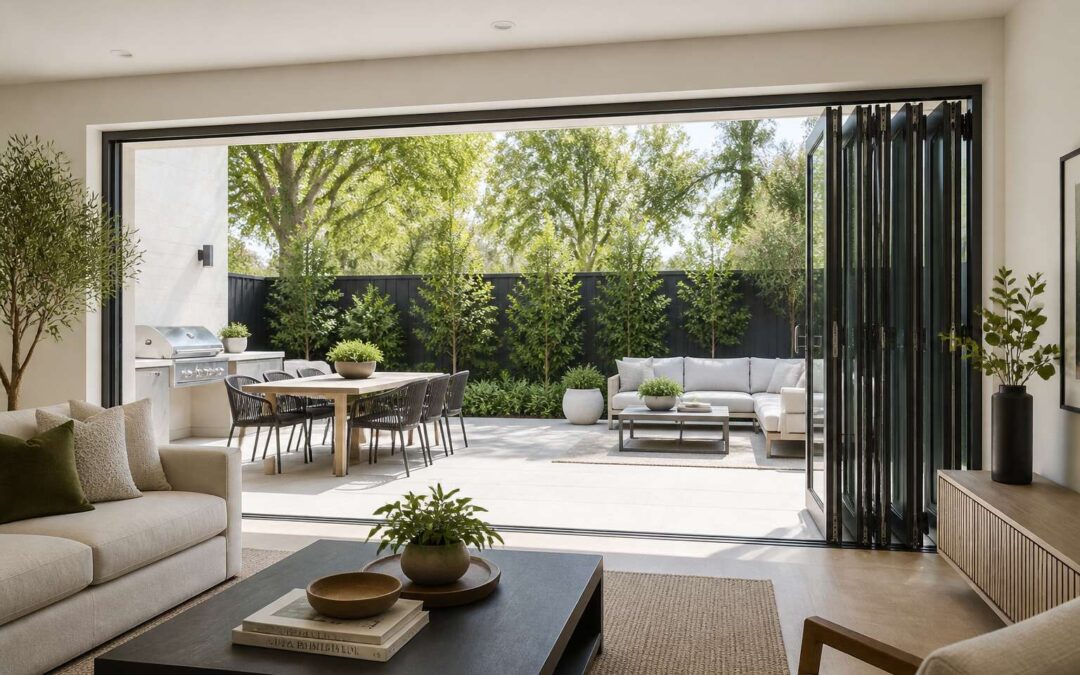
South Africa’s hard sunlight gives architects a chance to think differently about the shell of a building. A five metre run of aluminum folding doors can replace a solid partition with a transparent threshold that floods the space behind it with daylight.
This move does more than brighten a room. It reorders sightlines. The eye travels through the glass towards the valley or the suburb beyond, and the floor plan feels larger because the view expands past the walls. Thermal performance stays controlled, so the opening works year-round.
Homeowners notice the effect on daily life.
- Morning light reaches deeper into the living area.
- Natural ventilation pushes stale air out without a fan.
- The boundary between kitchen and patio disappears.
These changes make a house feel less like a container and more like a place in the landscape.
Creating Flexible Living Zones
South African homes are increasingly designed for how we actually live, not how we pose. This is where aluminum folding doors transform a house into a series of adaptable rooms. When the doors are closed, the study or media room becomes a quiet enclave, shielded from the clatter of the kitchen. When they fold away, those same spaces merge into a single, lively setting for a weekend braai or a quiet Sunday stretch.
The value lies in the range of configuration. Each placement of the panels changes the flow of the house.
1. A complete pocket for private moments.
2. A single meter opening to allow for airflow while maintaining separation.
3. A full recess to blend all interior zones into one continuous floor space.
This flexibility is a practical response to the way families gather. We might start the afternoon with the doors shut to keep the cool air in, then fold them back by evening. The hardware operates smoothly, so the transition is immediate. Over time, we find ourselves rethinking the need for permanent interior walls altogether, using these systems to divide and unite our spaces on our own terms. It is a quiet form of architecture that bends to the rhythm of daily life.
Enhancing Indoor-Outdoor Connectivity
South Africa’s temperate climate encourages a continuous relationship between covered and open air living. The architectural challenge is maintaining this connection while preserving the building’s thermal and structural performance. Aluminum folding doors address this by acting as a retractable wall system. When the panels stack away, the opening between patio and living space disappears, leaving only the continuous flow of the floor plane.
The technical benefits are specific:
- Flush threshold tracks that sit level with the flooring, allowing a seamless transition between interior tile and exterior stone
- Slim profiles that maximise the visible glass area while maintaining the rigidity needed for wide spans
- Multi point locking mechanisms that secure each panel without visible hardware clutter
This approach changes how the building envelope performs. Aluminum folding doors become the interface between the controlled interior climate and the natural environment outside, offering a single, elegant system for opening up or closing off the home.
Material and Performance Specifications
Aluminum Alloy Grades and Corrosion Resistance
The Great South African Weather Truce has held for decades, yet few home fixtures have ever negotiated its terms. Coastal salt spray, Highveld hail, and the joburg sun all demand a truce from your hardware. The alloy used in your aluminum folding doors is the peace treaty itself.
Beware the architect’s sweet talk about “marine grade” everything. It’s a convenient selling point, but much of it is marketing fluff. True durability starts with the temper, not the label. The industry standard is 6063-T5, an alloy treated for structural integrity and a smooth, anodizable finish. T6 tempers offer slightly higher strength but with a more brittle edge. For domestic use, T5 provides the perfect compromise between sturdy behavior and the complex physics of folding corners.
Here is why the alloy grade matters for your wallet:
1. It dictates how well the frame resists bending during frequent, daily use.
2. It determines how consistently the powder coating adheres, preventing premature peeling.
3. It influences the tolerance for making tight, weatherproof seals in the frame joints.
Corrosion resistance, specifically for the Cape and KZN coasts, comes from the surface treatment, not the core metal. The raw aluminum is too eager to oxidize. You need a proper anodizing bath or a quality powder coat. A decent anodized finish creates a hard, insulating layer that salt water struggles to penetrate. The powder coat on your aluminum folding doors acts as the sacrificial layer, protecting the frame so you don’t have to spend your weekends sanding and repainting.
Weatherproofing and Multi-Gasket Sealing Systems
A coastal storm in the Western Cape can test the limits of any home fixture, but the true measure of your entrance lies in the quiet, hidden engineering. The performance of your aluminum folding doors is defined by the integrity of the seals when the wind howls and the rain drives sideways. A single millimeter of weakness here becomes a lifetime of draughts.
The multi-gasket system is the primary defence in this theatre of weather. You are not looking for a single strip of rubber, but a network of interlocking fins that compress against the frame. Look for a system with at least two, ideally three, sealing points around the entire perimeter. This triple compression creates a buffer zone that neutralises the pressure difference between the inside and outside air, preventing moisture from being sucked through the threshold.
Specific materials matter in this region. Synthetic EPDM rubbers outperform natural rubber here. They resist the bleaching effects of UV light and the drying effects of the Highveld wind, staying supple for years rather than cracking.
The corners are the mortal enemy of this system. If the seals are merely butt-jointed, they will shrink and pull apart. Proper welding or vulcanising of the gasket corners ensures an unbroken, watertight loop.
The performance outputs of a well-sealed system are rather tangible:
- Reduced noise pollution from traffic or hail.
- Elimination of dust ingress during the dry months.
- Consistent internal temperature near the glazing.
When you close the panels, you should feel a firm, pneumatic resistance. That suction is the sound of the multi-gasket sealing system doing its work, creating a physical barrier that keeps the interior spaces truly separated from the elements. It is this engineering that makes the wide-open aesthetic viable, ensuring the glass wall is not a luxury, but a reliable fixture for the South African climate.
Glazing Options: Single, Double, and Triple Pane
The glass itself is where aluminum folding doors become a study in thermal physics. Single pane offers minimal resistance, fine for temperate days, but double glazing with argon gas creates a stagnant air pocket that halts heat transfer. Triple pane takes this further, adding a second cavity for extraordinary insulation, though the added weight demands stronger hinges and tracks.
Choose based on your microclimate:
– Single: budget friendly, for covered patios
– Double: the coastal standard, dampens road noise
– Triple: for Highveld winters or noise-heavy suburbs
I have personally seen triple glazing reduce interior temperature swings by several degrees. The spec sheet matters, but the lived comfort tells the true story for any aluminum folding doors installation.
Thermal Break Technology and Insulation Values
Thermal break technology separates the interior frame from the outside world. Within aluminum folding doors, a polyamide strip bridges the two halves of the profile, cutting heat flow through the metal. Without it, the frame becomes a thermal expressway. With it, U values drop as low as 1.8 W/m²K, figures ordinary metal frames cannot touch.
The insulation story continues in the profile chambers. Deeper extrusions create multiple air pockets. These pockets slow heat transfer, holding back the Karoo cold or Durban humidity.
South African summers punish glazing. Highveld frosts punish it harder. Thermal break performance separates premium aluminum folding doors from cheap reproductions. Ask for the certificate. The number tells you what comfort will cost.
Installation Process and Structural Requirements
Assessing Installation Opening Dimensions and Tolerances
A 2 mm discrepancy in an opening can compromise the entire folding mechanism, turning a seamless installation into a costly headache. For aluminum folding doors, the structural requirements begin long before the frames arrive. The supporting lintel or beam must carry the load of the glazed panels, and the floor must be perfectly level to prevent binding.
Assessing installation opening dimensions demands precision. You need to measure the width, height, and depth at multiple points, not just the corners. Tolerances typically range between 5 mm and 10 mm, depending on the manufacturer’s specifications. Consider these critical checks:
- The diagonals should match within 3 mm to avoid a parallelogram.
- The wall reveals must be plumb, or the alignment will suffer.
- The threshold should have adequate drainage fall, around 2 degrees.
A warped opening will force the aluminum folding doors to bear uneven stress, leading to premature wear on the rollers and gaskets. Always verify the structural substrate before ordering, as corrective work on site is far more expensive than upfront measurement.
Load-Bearing Headers and Track Preparation
The load-bearing header is the silent workhorse of any installation. A steel lintel or reinforced concrete beam above the opening transfers the structural weight, not the folding door itself. If the header deflects even a few millimetres, the track will bow and the panels will bind. For top-hung systems, the header carries the full weight of every glazed panel, so its specification must be verified against the manufacturer’s load charts before ordering.
Track preparation demands a dead-level substrate. The floor receives the bottom track in most South African homes, and any softness in the screed will translate into roller wear within months. The track should be anchored to a rigid substrate, never floating on grout alone.
- Verify header deflection under live load conditions
- Confirm the track screed is level within 1 mm per metre
- Allow thermal expansion gaps in runs exceeding 6 metres
Expansive soils common in Gauteng and coastal regions can shift foundations subtly over time. This movement transfers directly to the track, so flexible anchor points and regular adjustment checks keep the aluminum folding doors operating smoothly for decades.
Flush Floor Tracks Versus Raised Header Systems
No two installations of aluminum folding doors run the same sequence. Flush floor tracks sit inside a rebate cut into the screed, which means the concrete work has to be finished before the track is anchored. That order is critical. A raised header system instead carries the panel load on the steel above, leaving the bottom track as a simple guide, so the header must be shimmed and levelled first.
The choice shifts the labour and the tolerances in different directions:
- Flush tracks demand precise rebate depth before the screed cures
- Raised headers require exact header alignment before any glazing is hung
- Flush tracks suit thresholds that must stay level for wheelchairs or prams
Installers who respect this sequence get years of smooth operation. Those who rush it fight binding panels and worn rollers before the first rainy season.
Professional Installation Versus DIY Feasibility
The installation of aluminum folding doors demands precise measurements and patient hands. Each panel hangs, aligns, and locks in sequence, and a single millimetre of error multiplies across the stack. Professional crews spend hours adjusting rollers, checking reveal gaps, and testing the fold before they call the job complete. This is not a task for the casual weekend renovator.
Structural requirements come first. The lintel above the opening carries the load, while the floor slab must remain dead level. Without those fundamentals, no amount of fine-tuning will save the doors from sagging or scraping. A professional installer brings:
- Laser levels and torque wrenches for exact alignment
- Experience with shimming heavy track systems
- Knowledge of local wind load standards and coastal corrosion risks
DIY attempts at fitting aluminum folding doors often founder at the sealing stage. Water ingress and binding panels follow soon after. Let the experts handle the complexity, because the cost of a failed installation far exceeds the saving.
Common Pitfalls in Alignment and Leveling
The murkiest problems with aluminum folding doors rarely begin at the track. They start with a foundation that shifts by a few millimetres, or a header that flexes under load, and end with panels that scrape the sill every time you try to open them. Alignment is a game of absolutes. The floor must be dead level across the entire width of the opening, and the head jamb needs to be perfectly parallel to that surface. When those two planes diverge, the fix is never cosmetic. Adjusting the rollers can only compensate for a few millimetres of error; beyond that, you are fighting physics.
Leveling issues tend to surface in the fold. A panel that drops slightly on its hinge will catch the track, while a panel that sits high will slap against the header. These failures compound as the stack grows, turning a smooth operation into a noisy, forced movement. Here is what goes wrong in practice:
– The floor slab has a subtle crown or dip from poor finishing, which makes the entire bottom rail sit on an uneven plane.
– The aluminium frame is shimmed at the ends but unsupported in the middle, allowing the header to bow under its own weight.
– The track is mounted before the surrounding masonry settles, so the entire system ends up torqued by the time the building finishes curing.
The real test is opening the door halfway and stopping. If the panels hang freely in that position without binding, the geometry is sound. If they drift or resist, the fault lies in the structure, not the hardware. This is why the specification for the opening matters as much as the quality of the aluminum folding doors themselves. A perfectly manufactured product will perform poorly in a poorly prepared aperture. The sequence of work is everything: measure, brace, shim, and then measure again. Only after the structural tolerances are verified should the track ever touch the floor.
Maintenance and Longevity for Folding Door Systems
Routine Cleaning of Glass Panels and Frame Surfaces
Regular cleaning is not a chore, it is the primary payment on your aluminum folding doors’ longevity. The accumulation of dust in the lower tracks acts as an abrasive, a fine sandpaper that slowly wears down the smooth action of the rollers. For the frame surfaces, a simple mixture of warm water and a mild detergent works best. You should avoid acidic or alkaline cleaners, as these can strip the anodized or powder coated finish. A soft cloth or a sponge with a gentle touch is all you need to maintain the crisp architectural lines.
The glass panels present a different requirement, as they bear the brunt of the weather and the touch of curious fingers. A daily or weekly wipe down prevents the build up of hard water stains, a common issue in South Africa’s sunbaked regions. By maintaining a consistent schedule, you ensure the seals remain free of debris that can compromise their flexibility over time. Here is a simple routine to keep your system operating smoothly:
– Wipe the glass with a squeegee to prevent residue.
– Lubricate the rollers and hinges with a silicone based spray.
– Check the drainage holes in the bottom track for blockages.
The care you provide today determines the operational smoothness years from now. A door that glides without resistance is the result of this consistent, simple attention. This routine protects the investment made in the engineering of the system itself. The reward is a mechanism that remains as fluid and responsive as the day it was installed. Simple, periodic care secures the daily pleasure of the view that aluminum folding doors provide.
Lubricating Rollers, Hinges, and Locking Mechanisms
Aluminum folding doors demand more than surface care. The rollers carry the full weight of every panel, and each hinge endures years of articulation. When these moving parts run dry, the mechanism grinds and binds, undermining the engineering that makes the system work.
Silicone based lubricants protect the smooth operation. Petroleum products attract dust and oxidize into a paste that accelerates wear. A sparing application, followed by cycling the doors, distributes the protective film where it matters.
The locking mechanisms deserve equal attention. A latch that stiffens or a key that resists indicates a mechanism in trouble. Dry PTFE spray preserves the internal action without attracting grime.
The regularity of this maintenance determines the lifespan of the system. South Africa’s climate, from Highveld dust to coastal humidity, places relentless demands on aluminum folding doors. The moving parts work hard every day. Keeping them lubricated is the difference between a door that glides for decades and one that fails prematurely.
Replacing Worn Weatherstripping and Gaskets
Gaskets endure harsh sun and the constant flex of opening. The rubber loses pliability, and the seal fails silently. A worn strip allows Highveld dust to settle on the internal tracks. For aluminum folding doors, this signals the start of premature wear.
Replacement means removing the old strip, cleaning the groove, and pressing in a new profile. Many owners defer this task until the damage becomes visible.
- Cracks along the surface
- Brittle texture that flakes
- Light visible through closed seams
Coastal salt air and inland radiation both shorten the lifespan of these components. A quick inspection every season maintains the barrier.
Periodic Hardware Inspection and Hardware Tension Checks
Hardware tension drifts with use, temperature, and time. A system that opens smoothly today can strain tomorrow, and the adjustment is often imperceptible. For aluminum folding doors, the hardware carries a load that shifts with season and usage patterns.
Periodic hardware inspection reveals what the eye misses. Resistance in each hinge changes. A roller loses alignment, and the grind is subtle. The locking mechanism should catch with confidence, not a hesitant click. These details matter most in aluminum folding doors, where multiple panels pivot on shared tension.
- Tension that feels tight in winter loosens by summer.
- Highveld dust accumulates in the adjustment slots.
- Coastal humidity alters the metal’s response to torque.
These variations are normal. The fault lies in ignoring them. We wait for the door to announce its failure, but it never does. The hardware erodes gradually, and the only defense is attention.
Cost Factors and Return on Investment
Price Determinants: Glazing, Finish, and Configuration
Price determinants for aluminum folding doors are often misunderstood. The glazing specification alone can shift a project quote by a significant margin. Double glazing costs more upfront, but it changes what you spend on heating and cooling throughout the year. The finish matters equally. A standard anodised profile and a powder coated one differ in price and in long term durability.
Configuration is the third variable. More panels mean more hardware, more track, and more installation labour. A two panel setup is not the same value proposition as a four panel system.
– Panel count drives hardware costs.
– Stacking direction determines track length and floor preparation.
– Leaf size influences glass thickness requirements.
Return on investment depends on how the doors alter the way you use your home. A well specified set of aluminum folding doors adds usable floor space and improves light flow, which matters to buyers when the property goes onto the market.
Energy Efficiency Savings Over Time
South African electricity tariffs have climbed sharply, changing the value equation for any building product. With aluminum folding doors, energy efficiency savings over time often outweigh the upfront cost difference. A poorly sealed system leaks treated air hourly, and that leakage appears on your monthly utility statement. The real gap between a budget door and a high performance system is not the sticker price. It is the cumulative cost of wasted heating or cooling.
– Thermal break quality controls heat transfer through the frame.
– Gasket compression controls air infiltration directly.
– Glass specification manages solar heat gain.
Installation costs include structural work for the opening. Header and track preparation add expense, but prevent alignment issues breaking the seal. Sun load varies by orientation. A west facing installation without low E glass punishes you each afternoon. The return on investment is clear when energy savings are weighed against extra spent on better components.
Impact on Property Resale Value
Property valuations in South Africa depend on first impressions. Aluminum folding doors signal structural integrity to buyers, and that perception carries monetary weight. Cost factors extend beyond the door itself. Site conditions, lintel reinforcement, and specialised labour shape the final invoice. Sellers who invest in quality recover a meaningful portion at transfer.
Installation records matter during negotiations. Buyers fear hidden maintenance costs, so documented proof of proper installation reduces perceived risk. This assurance translates into firmer offers.
- Frame grade determines longevity under coastal corrosion
- Hardware brand affects daily operation and maintenance expectations
- Glass package influences comfort and security appeal
Property practitioners in Johannesburg and Durban report that homes featuring premium aluminum folding doors spend fewer days on market. Buyers recognise the expense of retrofitting such systems later. A well documented installation adds credibility during price discussions. The return on investment materialises through faster sales cycles and stronger offers.
Financing Options, Rebates, and Incentives
A price quote for aluminum folding doors is merely the opening bid in a longer negotiation with your own property. The final figure reflects site conditions, structural preparation, and the specialised labour required for installation. These costs are seldom a surprise to the seasoned homeowner, yet they remain the most common source of budget overruns in renovation projects.
The financial calculus shifts when you consider the alternatives. Retrofitting a less durable system or repairing a poorly installed one often exceeds the initial savings. South African homeowners are increasingly exploring structured finance options. Home improvement loans, revolving credit facilities, and supplier-specific payment plans have made these systems more accessible. Some leading manufacturers also offer seasonal rebates for multi-panel configurations, which reduces the effective price per square metre.
– Verify if your home insurance premium adjusts favourably with security-rated glazing.
– Confirm whether the installation qualifies for energy efficiency incentives through your bank’s green housing loan programme.
– Check if the supplier’s warranty becomes transferable, which adds value at resale.
Treat the investment as a capital improvement rather than a simple purchase. The operational savings from thermal efficiency and the reduced need for replacement hardware contribute to the overall return. Financing, when structured over a sensible term, allows you to preserve cash flow while upgrading your living space. This approach turns a significant expense into a manageable asset.
Warranty Coverage and Long-Term Ownership Costs
Few homeowners price the true cost of aluminum folding doors beyond the initial invoice. The real expense hides in warranty fine print and the silent wear on rollers and gaskets years later. Site access and crane requirements can add 10% to 20% to a quote, yet these factors seldom appear in brochures.
Return on investment for aluminum folding doors develops over decades. A well-built system serves for 20 years or longer, while cheaper alternatives fail before their tenth birthday. Operational savings from reduced maintenance and fewer hardware replacements compound quietly; the upfront premium becomes easier to justify.
- Check whether the warranty covers labour or only replacement parts
- Confirm if the warranty transfers to the next owner at resale
- Ask for the expected service life of rollers and locksets
Long-term ownership costs hinge on the warranty’s depth. Some manufacturers cover the aluminium frame for two decades but exclude the moving parts that actually wear out. Read those exclusions carefully before signing! A door is only as durable as the contract that stands behind it.