
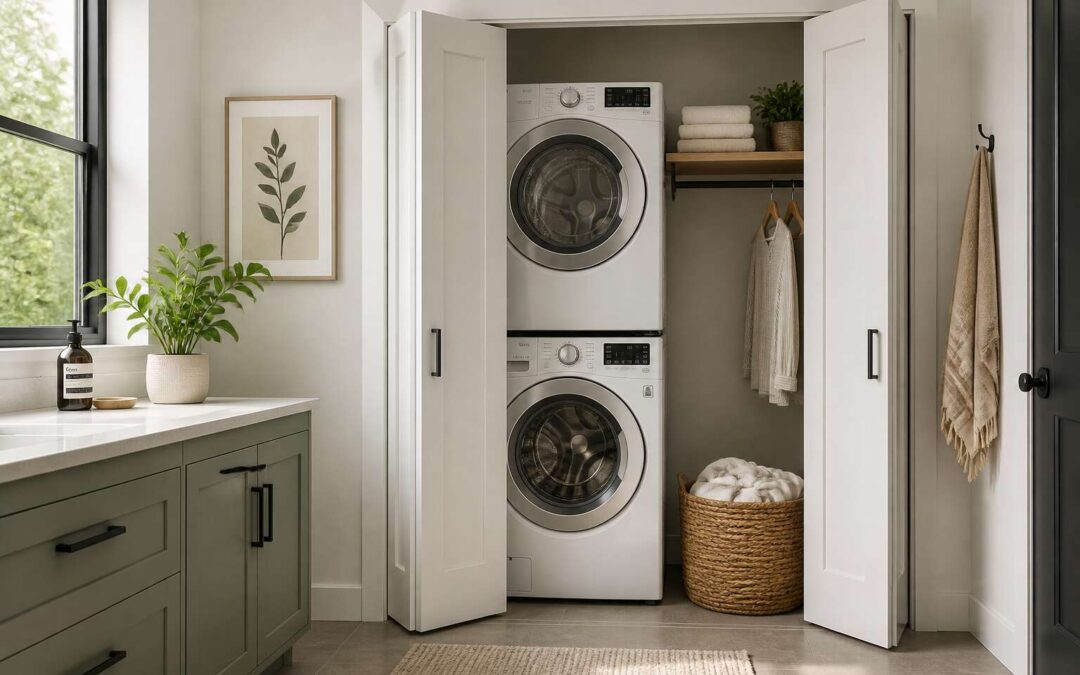
Space Optimization with Folding Doors in the Laundry Room
Benefits for Compact Laundry Areas
Compact laundry areas in South African homes often feel like an afterthought. A narrow passage or a corner in the garage becomes the designated spot for machines, baskets, and supplies. Folding doors laundry systems turn this cramped reality into a functional zone by hiding the workspace completely when it is not in demand.
Closing the doors creates a visual break between the utility corner and the rest of your home. Noise and lint stay contained, while the flexible panels allow full access to the machines without needing swing clearance. This is particularly valuable in older houses where the laundry area sits next to a dining room or a hallway. The practical advantages are clear:
- Adapts to awkward recesses and under staircases
- Keeps dust and moisture away from living areas
- Allows natural light through when using translucent slats
For anyone renovating a small laundry nook, folding doors laundry designs provide a neat solution that respects both your floor space and your daily routine. The result is a tidier home without sacrificing functionality.
How Folding Doors Save Floor Space
A standard hinged door needs a full 90 degree swing arc. In a laundry room that is often less than 1.2 metres wide, that arc occupies the very space where you need to stand. Folding doors laundry designs collapse that footprint entirely. The panels stack aside, so the floor in front of the washer stays open for baskets, sorting, or a quick bend to pull out the lint filter.
I have watched this change turn a cramped passage into a usable nook. The difference is immediate! Consider what changes when you swap your swing door for folding doors laundry:
- You gain the full width of the doorway for loading
- You can place a trolley or bin against the closed doors
- You avoid the dents a swinging door leaves on adjacent walls
Every square centimetre counts, and folding panels respect that.
Integrating with Built-In Storage Systems
The most overlooked asset in a laundry room is the air between the door and the wall. Folding doors laundry systems turn that interstitial space into a functional plane. When you mount the track flush and use top-hung hardware, the entire wall remains clear. You can then attach slim shelving, a fold-down ironing board, or a retractable drying rack directly against the panels. Nothing protrudes into the walkway.
I have seen homeowners gain an extra 300 mm of storage depth simply by opting for folding doors laundry designs over hinged alternatives. The key is to coordinate the hinge spacing with your shelving brackets.
- Recessed tracks allow cabinets to sit flush above the door
- Panel-mounted hooks hold reusable shopping bags without catching
- Magnetic strips on the inner face secure loose screws and keys
This integration demands precision. The reward is visible in the clean lines and accessible storage.
Creating a Multi-Functional Zone in the Home
A 2022 survey of Johannesburg households found the average laundry room spans only 1.8 square metres. That forces every centimetre to perform double duty! Folding doors laundry systems let you carve the space into distinct zones that shift with the day. Morning washing, evening folding, weekend bulk drying. The panels slide away to open the entire floor for a large sorting job, then close to conceal machines mid cycle.
In my own scullery, the folding doors laundry setup splits the room into a wet zone and a dry zone. The dry side holds a countertop that folds down for ironing. The wet side stays open to air out damp loads.
- A single track can section off the ironing station without losing wall access
- Angled panels create a temporary walkway around a stacked washer dryer
- A track mounted at 2100 mm keeps the ceiling line unbroken
That partition turns a dead corner into a flexible workspace. The result is a laundry room that works for narrow loads and full wash days alike.
Choosing the Right Material for Laundry Environments
Water-Resistant Options That Withstand Moisture
The laundry room presents constant humidity. Water splashes, steam rises, and damp fabrics linger. I have seen folding doors laundry installations fail when the material cannot tolerate this moisture. Choose phenolic resin boards or marine-grade plywood with a sealed core. These substrates resist cupping and delamination. In coastal South African homes, salt air adds another layer of attack.
A reliable system includes:
- High-pressure laminate bonded to waterproof particleboard
- Powder-coated aluminium panels with a lightweight honeycomb core
- Polypropylene sheets with a smooth, non-wicking face
Each option holds up against splashes and condensation. Hardware must be stainless steel, not galvanised alone. A set of folding doors with sealed edges will keep its shape for years. Avoid medium-density fibreboard entirely. Moisture makes it swell. Choose deliberately, and your laundry remains functional and dry.
Durability Against Heat and Humidity
Heat and humidity combine to degrade materials that survive either condition alone. The folding doors laundry systems that endure this environment rely on substrates with low thermal expansion. A laundry room that runs a dryer and a geyser simultaneously pushes surface temperatures well past what standard panels tolerate. Acrylic-faced panels resist warping when the air gets thick with steam, and they hold their colour when exposed to repeated temperature swings.
Consider the core structure before the finish. A phenolic resin core handles both heat and moisture without softening. Aluminium honeycomb panels dissipate heat rapidly, keeping the surface stable even when the room feels like a sauna. The adhesive layer matters just as much as the face material, since poor bonding fails first under thermal stress.
- Verify the adhesive rating for high heat exposure
- Check the coefficient of thermal expansion for the facing layer
- Confirm the edge sealant tolerates repeated condensation cycles
A folding doors laundry solution with the right core keeps its geometry intact, so the panels glide smoothly no matter how many steam cycles pass.
Easy-to-Clean Finishes for Busy Households
A laundry room tests materials harder than any other space in the home. The finish determines whether your folding doors laundry solution becomes a daily chore or a seamless routine. In South African homes, where hard water and frequent loads are the norm, the surface must keep up.
A smooth, non-porous laminate or vinyl wrap resists the detergent residue that settles on panels after months of use. A quick wipe with a damp cloth restores the sheen. Textured surfaces look elegant but trap lint and dust in their grooves.
The core material matters too! High-density fibreboard with a moisture-resistant seal offers stability without the premium cost of solid wood. Your folding doors laundry panels should resist splashes from the basin and knocks from a moving basket.
Choose finishes that forgive rather than punish. Glossy surfaces show every fingerprint, while satin or matte masks the smudges of busy hands.
Aesthetic Materials for Modern Laundry Designs
Every laundry room has a material that secretly despises it. Your folding doors laundry setup will either survive the humidity or slowly confess its weakness. Aluminium extrusions shrug off moisture that turns timber into a warped mess, while powder-coated steel offers a matte presence that forgives the odd detergent splash. Phenolic panels hold their colour when morning sun hammers through a north-facing window.
- Aluminium: structural strength without the sag
- Phenolic: density that resists knocks and stains
- Powder-coated steel: a surface that ages gracefully
Aesthetic materials for modern laundry designs lean on texture and tone. A black frame reads as deliberate architecture; a warm bronze track softens the clinical feel. When the folding doors laundry unit aligns with your cabinetry, the room gains a collected, intentional character.
Budget-Friendly Choices Without Sacrificing Quality
Budget constraints often push homeowners toward the cheapest folding doors laundry hardware available. That is a mistake. High pressure laminate panels mimic premium timber finishes without the accompanying price tag. PVC tracks glide quietly and tolerate damp conditions, even if they lack the structural prestige of metal. A modest budget still allows for a dependable setup.
Consider these workable options:
– PVC framing for cost effective stability
– Laminate surfaces that imitate natural grain
– Aluminium hinges that resist rust
Acrylic inserts offer transparency without the fragility of glass. The right material choice protects your investment while keeping the overall expense reasonable. A folding doors laundry system approved for everyday use does not require luxury fittings. It requires components that understand their environment. Match the substrate to the room’s moisture load and you will not sacrifice quality for affordability.
Installation and Retrofit Guidance
Measuring Your Doorway Accurately
The doorway rarely reveals its true dimensions at first glance. A tape measure drawn across the opening exposes what the eye prefers to forgive. For folding doors laundry installations, the rough opening dictates everything that follows, and yet most homeowners measure only once, at eye level, where walls behave themselves.
Measure at the top, middle, and bottom of the width, because lintels sag and floors settle. Record the narrowest figure. Check height at both jambs and the centre. Depth must accommodate the track and folded stack.
– Steel tape, never fabric, for accuracy
– The rough opening, not the finished architrave
– A spirit level to expose hidden slopes
South African homes, layered with decades of renovation, conceal their eccentricities behind plaster. Retrofit work demands reverence for what exists. The opening that measures true will carry folding doors laundry without complaint, year after year.
Do-It-Yourself vs Professional Installation
Retrofitting folding doors laundry into an older South African home is a delicate surgery. The walls have shifted, the doorframes have settled, nothing sits square. Some attempt the work themselves, armed with a drill and hope. Others call a professional who understands old plaster and the exact nature of a misaligned track.
DIY saves money but demands time and an honest assessment of your own skill. The track must hang level, the pivot points align, and the folded stack must retreat without scraping the floor. A professional charges more, yet they carry the tools and patience for the unexpected. They have seen the hidden stud, the uneven jamb, the ceiling that dips.
- Assess your comfort with levels, shims, and drills
- Confirm the track can bear the door weight
- Consider the cost of mistakes versus the cost of labour
The decision rests on your tolerance for risk. Folding doors laundry is not forgiving!
Converting Existing Swinging Doors to Folding Panels
A swinging door claims nearly a square metre of floor every time it opens. Converting it to folding panels begins with removing the old door and its hinges. The frame stays, but it demands scrutiny. Check for squareness with a spirit level. Old South African homes settle unevenly, leaving a jamb that looks straight but measures otherwise.
The track mounts to the head jamb. A common mistake is assuming the existing frame can bear the new load. Reinforce with blocking where the screws bite. The panels stack to the side, clearing the washer’s loading zone. For folding doors laundry, this conversion returns the floor space that the old door swept away.
- Measure the clear opening after removing the door
- Shim the track to achieve level
Retrofitting is not a straight swap. The old door opened into the room. The folding panel tucks into the frame, giving you back that half metre. Most folding doors laundry setups gain a full step of movement once the swing door disappears.
Adjusting Clearances for Washer and Dryer Access
Once the swing door is gone, the real work revolves around clearances. Front loaders need roughly 600mm of pull-out room for filter access, and that space only exists if the folding doors laundry panels stack clear of the washer lid. Set the track stops so the panels park flat against the jamb, not halfway across the machine.
Most installations fail not because the door is wrong, but because the stack depth was never measured against the appliance fronts. Adjust the track stops first, then check the bottom pivot guides.
- Loosen the track stop screws and slide the panels into their resting position
- Tighten the stops once the panels sit flush with the jamb
- Test the full fold and unfold cycle before loading any laundry
These small shifts in hardware placement determine whether you can pull the dryer forward without wrestling the panels out of the way. I have seen contractors skip this and then shave the panel edges, which ruins the finish. Measure twice, adjust once.
Securing Heavy-Duty Panels and Hinges
Heavy duty hinges carry real weight. A front loader with a stacked dryer can exceed 150 kilograms, and that load transfers straight to the pivot points. I have seen hinge blocks pull clean out of hollow wallboard within weeks. For folding doors laundry systems, the screws must bite into the masonry or timber frame behind the plasterboard. Use stainless steel hardware in coastal regions like Durban, where humidity corrodes zinc fittings fast.
Retrofit jobs demand attention to the existing frame, since the original door frame often provides the strongest anchor points for folding doors laundry panels. Mount the hinge plates perfectly plumb. A spirit level is non negotiable. Even a three millimetre slope in the floor track will cause panels to creep open on their own. Check every fixing point before you hang the doors!
Design and Style Integration for Laundry Areas
Blending Folding Panels with Laundry Room Decor
A laundry room is a domestic backstage, and the folding doors laundry setup usually announces that status with stark panels. The transition between the public house and the private utility can be a measured balance of texture and light. When integrating those panels with the surrounding decor, treat the door as a large-scale textile! In Cape Town homes, where coastal light is stark, a matte finish or a wood-grain laminate softens the visual impact. Think of the panel’s surface as a backdrop for your storage systems.
- Match the panel’s groove profile to your cabinetry handles.
- Use a contrasting colour for the track to draw the eye upwards.
- Incorporate wall-mounted planters beside the panels.
This integration questions the precedence of utility over aesthetics. When the panels slide open, they reveal a space that feels intentional, not relegated. The harmony comes from rejecting the idea that folding doors laundry are a separate, lesser domain.
Using Glass Inserts and Louvered Vents
In a country where utility spaces often double as storage for camping gear and pet food, the folding doors laundry setup must earn its visual place. Glass inserts change everything. They admit ambient light without compromising the panel’s structural integrity. Louvered vents, on the other hand, allow air to move through closed doors, preventing the musty smell that clings to damp towels.
Consider how these features shape the psychological feel of the room:
- Frosted glass diffuses harsh afternoon sun while hiding clutter.
- Horizontal louvers align with the linear grooves of the door frame, creating a cohesive rhythm.
- A single pane of clear glass at eye level lets you spot a fallen sock before opening the door.
For Cape Town homes, where salt air accelerates metal corrosion, choose anodised aluminium frames for both inserts and vents. This keeps the folding doors laundry functional without demanding a separate ventilation system.
Color Schemes and Visual Impact on Perceived Space
In a compact laundry, the eye reads wall color before it registers the appliances. Pale sage or soft greige on the walls recedes, making the folding doors laundry feel wider than its floor plan. Dark tones, by contrast, pull the boundary inward, which can work if the door panels themselves carry the light.
- Match panel colour to the skirting for a seamless wall effect.
- Use a contrasting frame to draw the eye toward the folding doors laundry as a design feature.
The visual weight of these panels against adjacent finishes matters more than the appliance brand. A matte charcoal frame against white tiled floors creates a deliberate anchor. For Cape Town’s bright coastal light, muted pastels prevent glare while keeping the room airy. The panel colour either extends the wall or becomes a sculptural focal point.
Hidden Folding Systems for a Minimalist Look
Hidden folding systems are the quiet achievers of minimalist laundry design. They tuck away completely, leaving only a clean run of wall or cabinetry when the doors open. The best folding doors laundry setups use flush tracks and concealed hinges so the hardware never competes with the material it supports.
Specifying a hidden system changes how the room feels. The wall becomes continuous, and the laundry zone reads as deliberate architecture rather than an afterthought. Choose panels that match the surrounding joinery exactly, birch ply for birch ply, laminate for laminate. The mechanism disappears; the surface does the speaking.
- Recessed floor tracks keep the threshold unbroken.
- Top-hung systems suit lightweight panels and clear floors.
- Pocket-style folding stacks hide entirely inside a cavity.
In Cape Town homes, this kind of integration suits the clean-lined coastal aesthetic. A hidden folding doors laundry system respects the palette you have already built, no extra trim, no visual noise. That restraint is exactly what makes the space feel larger.
Enhancing Accessibility and Workflow Movement
Most laundry rooms lose more time to awkward door swings than to the wash cycle itself. In a compact Cape Town space, a swinging door forces you to step back, hold the basket, and pivot. A folding doors laundry system instead collapses the panels into a tidy stack, making the entire appliance wall accessible without stopping.
Design integration for workflow means placing the fold lines where your body already moves. If you transfer wet clothes from washer to dryer, the door should open to expose both machines without obstruction. Accessibility also improves when the stacked panels sit flush against the side wall, leaving a clear path for a trolley or a wheelchair.
- Mount the folding track so panels rest completely out of the walkway.
- Choose a low-profile floor guide to keep panels steady while you move past.
This approach turns the laundry zone into a tool for efficiency, not a decorative afterthought.
Maintenance and Longevity Tips for Folding Door Systems
Cleaning Tracks, Rollers, and Hinges
South African Highveld dust and laundry lint are the two forces that will make your folding doors laundry stick. I have seen smooth tracks jam completely within a month of neglect. A weekly wipe with a damp microfibre cloth prevents that.
Do not wait for a squeak on the rollers and hinges. Silicone spray is the better choice; oil collects dust and becomes paste. The bottom pivot deserves attention too, as moisture pools there.
- Vacuum the track channel before wiping
- Remove hair and thread wrapped around rollers
- Wipe hinge pins with a dry cloth monthly
Catching a misaligned roller early saves the whole panel. A five minute screwdriver adjustment beats a full replacement, and your setup keeps sliding long into the future.
Protecting Against Rust, Mold, and Mildew
Rust begins where the protective coating ends, and your folding doors laundry lives in a climate that tests every seam. The Highveld’s dry winters and humid coastal summers attack metal hinges and pivot points from opposite directions. I have watched corrosion creep along a bottom track within two seasons. Quarterly inspections catch it early, and a dab of corrosion inhibitor on exposed screw heads takes seconds.
Mold and mildew prefer the fabric seals that line folding doors laundry panels. These gaskets trap moisture from a running dryer, so a monthly wipe with dilute vinegar stops spores from settling. Keep the drainage channels near your laundry sink unobstructed. Water pooling against the bottom rail swells wood cores and lifts laminates. These small habits cost little and preserve the entire folding system for years.
Lubrication and Periodic Adjustments
The moving parts of any folding doors laundry system demand specific care. A lithium-based grease, applied sparingly to pivot pins and roller bearings, outlasts general-purpose oils that attract lint and dust. I favour a dry-film lubricant for exposed tracks; it leaves no residue to capture fabric fibres from your dryer.
Periodic adjustments matter just as much as lubrication. Over a year, panel sag becomes noticeable when the leading edge starts catching on the floor. You can correct this by turning the adjustment screw on the bottom pivot, usually a quarter turn at a time. Check the tension on the top track guides as well.
- Tighten loose hinge screws before they strip the mounting holes.
- Align the centre meeting stiles so the gap remains even.
The tolerance on modern folding doors laundry hardware is forgiving, but only if you respect the interval between tune-ups.
Replacing Worn Seals and Gaskets
In coastal South Africa, the salty air and high humidity age rubber seals twice as fast as inland conditions. For any folding doors laundry setup, the gasket along the bottom edge is the first part to fail. Once it cracks, moisture sneaks past the panel and into your floorboards. Replace it immediately!
Inspect that seal every three months. Run your finger along the entire length. If you feel any hardness or visible splits, swap it out. Use a silicone-based sealant for the edges, not the lithium grease you use on moving parts. That grease softens the rubber and causes premature failure.
- Check the threshold gasket for compression marks.
- Look for gaps where the panels meet the frame.
- Test the door after heavy rain for any damp spots.
When installing a new seal, clean the groove with a mild detergent and dry it fully. Press the replacement in firmly, starting from one end. Avoid stretching it, as that creates weak points. A properly fitted seal keeps your folding doors laundry efficient and free from drafts and moisture.
Enhancing Sound Insulation Between Rooms
Your folding doors laundry transmits a washing machine’s spin cycle at 75 decibels through gaps in the panels. A 2 millimetre opening funnels that noise into the next room. The longevity of the system depends on keeping panels flush and silent.
Loose pivot brackets are the usual culprits. They let panels droop, creating triangular gaps that channel sound straight into the adjacent bedroom. Tighten them every season. Also check the floor guide; if it shifts, the whole door skews and the acoustic seal fails.
- Inspect the top track for debris that lifts panels out of alignment.
- Test the door’s latching pressure; a firm click means proper compression.
- Listen for rattles during operation, they signal worn buffer pads.
Addressing these small faults extends both the hardware’s life and its sound-stopping ability. A well-maintained folding doors laundry stays boringly quiet, which is exactly what you want.
Year-Round Care for Extended Durability
Every folding doors laundry system develops its own quirks after a year of use. The smooth slide you felt on installation day fades as dust settles into the bearing housings and humidity alters the panel edges. South African weather, with its sharp swings between dry heat and coastal damp, stresses the hardware more than most factory tests simulate.
Run the folding doors laundry through ten full cycles, then pause and observe the movement. A natural hesitation at the midpoint indicates track deflection, not user error. Address that before it causes the hinge pins to wallow.
- Examine the hinge plates for hairline fractures after heat waves.
- Verify the tension rods still hold their original clamping force.
Regular attention to these pressure points keeps the system operating for years without replacement parts.