
Understanding the Anatomy of Folding Doors
Materials and Construction: Aluminum, Vinyl, and Wood
Folding doors are masterpieces of concealed complexity, and their cuttable nature is determined far more by their skeleton than their skin. Aluminium systems are the darlings of modern renovations, prized for their slender profiles and remarkable rigidity. However, this strength is a double-edged sword. You cannot simply saw through an aluminium track without compromising its structural integrity, as the tension within the frame is what keeps the panels perfectly aligned during operation.
Vinyl, or uPVC, offers a forgiving alternative for the ambitious homeowner. Its cellular structure is more malleable, allowing an experienced carpenter to trim a few millimetres from the top or bottom with the right blade. The real question of whether can folding doors be cut to size often begins and ends with the complexities of the hardware. The hinges and wheel assemblies are precisely calibrated at the factory, and the permanent placement of these pivots dictates how the door will fold.
When you move to timber, you enter a world of both opportunity and peril. Solid wood is the most accommodating material, which is why older homes often feature bespoke joinery that was modified over decades of settling foundations. Yet, building movement is the enemy of precision. A wood door cut improperly will warp, and the alignment of the bullet catches will fail, leaving you with a symphony of rattles.
– Aluminium requires factory or specialist equipment for accurate structural cuts.
– Vinyl can be worked with standard woodworking tools, but only for cosmetic edge adjustments.
– Wood offers the most flexibility for field modifications, though seasonal swelling must be considered.
The material ultimately decides your fate. A modern aluminium installation will demand a consultation with an approved installer, because the coating and thermal break are part of the sealing system. In contrast, a simple replacement of a worn floor covering might allow you to shave a vinyl door’s bottom track to fit a thicker rug. Knowing exactly what your frame is made of will save you from a costly mistake. After all, the satisfaction of a perfectly folding partition rests entirely on the honesty of its construction, not the ambition of your tools.
Hinge and Track Systems: How They Accommodate Adjustments
Look first at the hinge and track geometry. Each pivot and trolley has a deliberate range of movement, and those few millimetres of play allow the door to settle with the building. A turn of the tension screw on the top pivot often corrects a sagging leaf, while the floor guide can be nudged to realign the stack. I have watched installers fix binding doors without one cut, simply by shifting a track bracket.
- Hinge screws raise or lower a panel to clear thresholds.
- Track end stops reposition the fold radius.
- Floor guides have lateral play for wall irregularities.
So the question of can folding doors be cut to size should begin with the hardware, not the saw. The track system absorbs a degree of imperfection, but only within engineered limits.
The Role of Panel Overlap and Stacking Space
Folding doors are a study in calculated proportions. Every panel relies on a precise overlap, that lip where one leaf tucks behind the next. That overlap is not decorative; it seals gaps and dictates how far the stack will compress. When someone asks can folding doors be cut to size, they are really asking whether that geometry can survive alteration.
Stacking space is the hidden counterpart to overlap. It is the exact width required for all panels to fold flat against one another. Because each panel shares a hinge and a pivot, cutting one leaf changes the entire fold radius. The stack may no longer align. A trimmed panel can also mean the overlap becomes misaligned, leaving drafts and exposed hardware.
- Panel overlap preserves weather resistance
- Stacking space determines the opening gap
- Both depend on original dimensions
Understanding these relationships matters before any modification, especially when the answer to can folding doors be cut to size depends on preserving the fold sequence itself.
Measuring Inner Frame Dimensions vs. Door Panel Widths
The inner frame width and the door panel width are two different numbers. Confusing them leads to a folded stack that refuses to sit square. The frame is measured across the opening at the top, middle, and bottom. The panels are measured edge to edge across each leaf. In a correctly installed door, the total panel width exceeds the frame width, because the hinges, track, and overlap all need space. I have seen homeowners trim panels to match the frame exactly, only to discover the door no longer slides or folds.
Consider the tolerances involved:
- The track stack needs 10mm to 15mm of clearance.
- Hinges add width on every joint.
- The leading edge needs a small gap for the latch.
Can folding doors be cut to size? The real question is whether the panels can be reduced without breaking this ratio. The answer depends on the frame measurement, not the panel width.
Feasibility of Size Adjustments for Different Door Types
Interior Closet Doors: Trimming Width and Height Safely
Carpenters in Johannesburg often report that a client’s excitement about a custom fit fades when the saw blade meets the lamination. The truth is, trimming interior closet doors is a practice of patience, not a simple act of cutting. While the panels themselves are often engineered with sacrificial edges, the hinges and the accordion mechanism demand precise tolerances. A few millimetres removed from the wrong side can misalign the entire pivot system, causing the fabric or wood to bind on the track.
You must first assess whether the door’s structure allows for a reduction. Normally, you can adjust the width by removing material from the outer stile, but the height is less forgiving. If you cut too much from the bottom, the door loses its glide. The track system compensates for minor floor irregularities, but it cannot fix a panel that has been shortened past its operational limit.
For a safe adjustment, consider the following points:
– Always remove material from the bottom edge to preserve the top rail alignment.
– Use a sharp, fine-toothed blade to prevent chipping the vinyl or wood veneer.
– Sand the cut edge immediately to remove splinters that could snag the track.
The question of can folding doors be cut to size hinges on the gap between your frame and the panel stacking space. When you measure, remember that the door needs room to breathe during the folding motion. A flush fit is your enemy here. The real skill lies in calculating the allowance for the hinges and the floor clearance. Only then does the saw become a tool of possibility, transforming a stock item into a bespoke solution for your home.
Exterior Patio Folding Doors: Structural Limitations
Exterior patio folding doors live under a different set of rules. While interior closet doors offer some room for surgical trimming, the glass, framing, and hardware on a patio system are engineered to specific structural loads. The glazing units are usually fixed within the frame, so any attempt to shorten the panel compromises the seal. The tempered glass, often double glazed for South African summers, cannot be cut after manufacturing. The thermal break, that crucial insulation layer inside the aluminium, stops at a predetermined point. Removing material from the bottom rail to adjust for a sloping balcony could expose the internal mechanism to moisture. The structural integrity of the entire wall relies on these panels distributing wind load effectively. You cannot simply ask can folding doors be cut to size when the answer involves a multi-point locking system that shoots bolts into the head and sill. Take, for instance, the fixed elements that define the operating envelope:
1. The height of the track and the depth of the header box.
2. The location of the pivot pins and wheel carriages.
3. The interlocking profiles on the meeting stiles.
These components are jig-assembled at the factory. Cutting the panels down removes the factory edge, destroying the clean line required for the gaskets to grip the glass. The reality is that exterior systems require a custom fabricated frame from the start, not a field modification. A few millimetres might seem insignificant, but on a 3 metre high door, the deflection under wind pressure becomes dangerous. The correct path is to measure the rough opening and order the system to suit, not to buy stock and hope for a miracle.
Accordion vs. Bi-Fold: Which is More ‘Cut-Friendly’?
Accordion doors and bi-fold doors fail at cutting in different ways. An accordion system depends on a consistent panel width across the entire stack. Reduce one panel by a few millimetres and the fold no longer nests cleanly. That throws off the whole concertina action. Bi-fold doors have fewer, wider leaves, so a small vertical trim is less likely to compound across the system.
- Accordion doors multiply every error across each folding segment.
- Bi-fold doors isolate a trim to just one or two leaves.
- Neither type accepts width changes without affecting the locking points.
So, can folding doors be cut to size? For either type, the answer is the same: only if you accept a loss of factory precision. The bi-fold is the more cut-friendly option, because there are fewer panels to go wrong. But we are talking about marginal trims, measured in millimetres, not a full resizing.
Custom vs. Stock Doors: Offers More Leeway for Trimming
Nearly all folding door warranties are voided by a hacksaw. This is the first fact to accept before you measure anything. For stock doors, the leeway is minimal. These units are mass produced to hit a price point, which means the components are thinner and the tolerances are tighter. Cutting a stock unit down by even a few millimetres can compromise the hinge alignment. That is risky.
Custom doors offer a different scenario entirely. They are manufactured to your exact opening, so trimming becomes a theoretical exercise rather than a practical necessity. However, the real advantage of a custom unit is the margin built into the side jambs and header. This allows for minor adjustments during installation without touching the door leaves themselves.
If you are working with a stock unit, you are bound by the following constraints:
– The factory drilled holes for hinges and track brackets are immovable.
– Any cut reduces the structural integrity of the stile.
– The finish on the cut edge will not match the factory coating.
The question of can folding doors be cut to size is really a question of which door you bought. A stock door is a fixed product. A custom door is a measured response to your wall. If you trim a stock door, you are adapting a product that was never meant for your space. If you trim a custom door, you are making a minute correction to a product that was already close to perfect. The latter is safe. The former is a gamble. For most South African homes, the only safe trim is a height reduction of less than 10mm on the bottom of the panels, and only if the manufacturer permits it.
Impact of Laminate or Veneer Finishes on Cutting Accuracy
Feasibility hinges on the door’s core and skin. Solid wood offers a clean cut, but laminate and veneer finishes betray the saw. The moment you slice through a laminated panel, you expose the particleboard core, which absorbs moisture and swells. Veneer is worse, as the thin wood layer peels or splinters along the cut line.
So can folding doors be cut to size? For vinyl, the hollow chambers crush. For aluminum, the extrusion loses its seal. Only solid timber tolerates a modest trim, and even then, the finish must be reapplied. Consider these factors before you reach for a saw:
- The cut edge will never match the factory coating.
- Sealing the raw edge is mandatory, or the panel will degrade.
- Pre-finished edges are cheaper than re-trimming later.
I have seen homeowners ruin a pristine veneer by trimming 5mm off the bottom. The exposed substrate screams against the smooth face. For most stock units, the answer is no. For custom doors, the margin is built in, so you rarely need to cut at all.
Tempered Glass Panel Considerations: Never Cut In Place
Tempered glass panels change the calculus entirely. Unlike aluminum or vinyl, glass cannot be trimmed, drilled, or sanded. Attempting to cut a tempered panel shatters it into granules, not shards. For folding doors with glass inserts, the answer to can folding doors be cut to size is a definitive no. The frame might offer a few millimetres of play, but the glass dictates the fixed dimension.
– The glass is heat-treated for strength, making post-production cutting impossible.
– Even a minor pressure point from a misaligned frame can cause spontaneous fracture.
– Seals and gaskets are sized to the original glass thickness, and any frame adjustment breaks that fit.
Never cut in place. Tapping a glass panel while attached to the track risks stress fractures that appear weeks later. For South African homes with coastal winds or highveld temperature swings, this risk multiplies. If your folding door has tempered glass, measure twice and order the exact size. There is no margin for error.
Step-by-Step Trimming Process for DIY Enthusiasts
Tools You Will Need: Circular Saw, Router, and Straightedge
The quiet tragedy of a beautiful door that does not fit is one every homeownEr can avoid. The answer to the question of whether folding doors can be cut to size is a definitive yes, provided you respect the material and your own patience. There is a particular satisfaction in taking a brand new panel and marking it with a pencil, knowing that the next hour will determine the grace of your entryway.
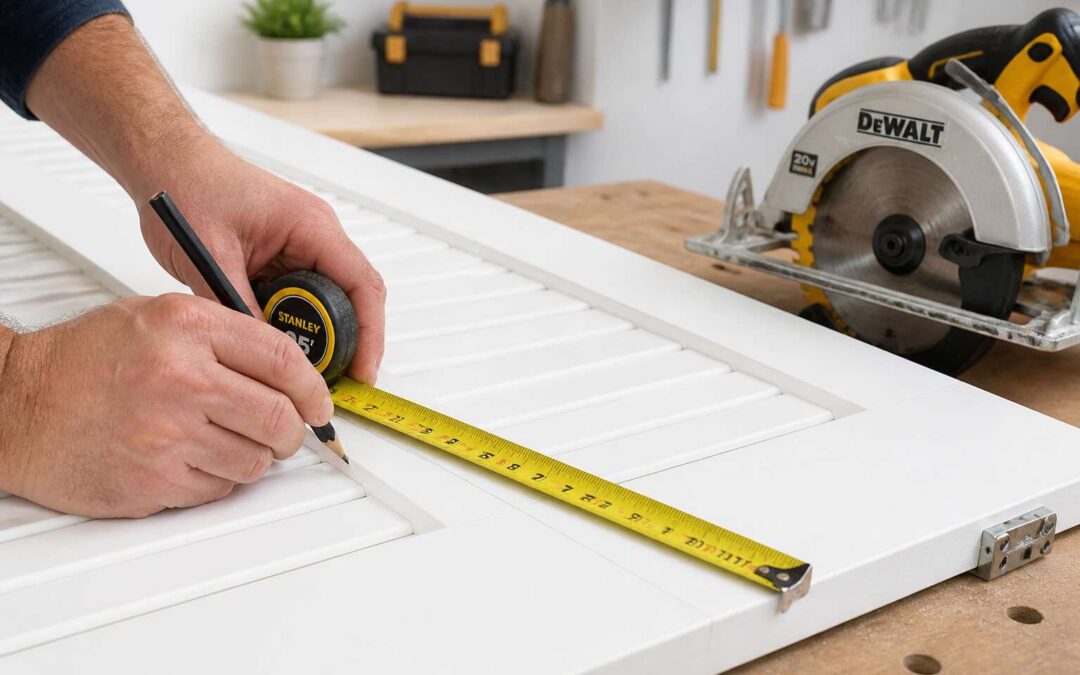
Begin by setting your circular saw to the correct depth. Place the straightedge across the panel, clamping it firmly to prevent any wandering. The track system will forgive you for a rough edge, but the veneer will not forgive a chipped surface. For the cleanest result, follow this sequence:
1. Mark your cut line with a sharp blade, scoring the laminate to prevent tear-out.
2. Clamp the straightedge to the waste side of the line.
3. Run the circular saw slowly, letting the blade do the work.
4. Smooth the new edge with a router to remove any residual splinters.
This process transforms a generic slab into a custom piece. You will find that the top and bottom rails of the panels require a slightly different approach than the vertical stiles. The router becomes your best ally here, allowing you to trim the height with the precision of a seamstress hemming a gown. Just remember to measure twice, and cut once, because unlike a dream, a saw cut cannot be undone.
How to Disassemble and Re-Hang Panels for Accurate Cuts
Impatience is the enemy of a straight cut, especially when you are dealing with a full door assembly. To get the accuracy you need for a folding door, you must remove the panels from their hinges and track entirely. Working on the floor with a stable work surface is non negotiable. You cannot control a circular saw while wrestling with a long piece of aluminium or a timber panel that is still attached to a rolling mechanism.
Once the door is flat, you can focus on the true geometry of the cut. The critical step is to replicate the factory edge. Do not assume the panel is perfectly square, because it might be out of line by a few millimetres. Measure the opening at the top, middle, and bottom, and transfer the smallest dimension to the door. Mark the cut line with a pencil and a long straight edge, then score it with a utility knife. This breaks the surface tension of the veneer and prevents the saw blade from tearing chunks out of the face.
After the cut is made, you will need to address the hardware. Hinge holes and pivot brackets are often positioned at specific heights. If you trim a significant amount off the bottom, those screw holes will be relocated. Do not force old screws into new positions. Fill the original holes with wooden dowels and a quality adhesive, let it cure, and then re-drill for the brackets. The alignment of the track and the floor guide depends entirely on this step.
When you re-hang the panels, do it in reverse order. Start with the top pivot pin into the track, then guide the bottom pin into the floor bracket. Spin the adjustment screws on the hinges to level the panels. The tension on the track system will pull everything tight, and the panels will close flush. If you follow this sequence, the final result will look factory made. The process is meticulous, but the question of can folding doors be cut to size is answered with a confident yes when you take the time to work cleanly.
One final detail often gets overlooked. The folding action requires clearance at the leading edge of the panel. If you cut the width too tight against the jamb, the door will scrape. Leave a 3mm gap on the latch side to allow for the swing. This small allowance makes the difference between a door that sticks and one that glides shut with a quiet click.
Correct Sequence: Cutting the Bottom, Top, and Sides
Let’s be honest about the process, since it is a three part exercise in discipline, not just a single swipe with a saw. The sequence matters more than the blade you choose, because physics and hardware both demand a specific order of operations. The bottom cut comes first, since this governs how the panel will clear your floor covering and whether the pivot pin aligns with the floor guide. Measure twice from the top edge, because that reference point will not change during this operation. Saw the bottom off with a sharp blade, then check the cut for squareness against a known straight edge.
The top trim follows, but only if the bottom cut failed to give you enough clearance. You will need to disassemble the top pivot bracket before you commit to that line. A quick list for clarity:
1. Trim the bottom to the final height minus 10mm.
2. Test fit the track components.
3. Trim the top only if the track sits proud.
4. Trim the latch side last.
The side cuts bring their own quirks, since the hinge knuckles on the opposite edge must remain intact. A router with a flush trim bit saves you from tearing the laminate, but a circular saw with a scoring cut works too. Leave that 3mm gap on the swing side, or your folding door will grind against the jamb with every action. This final sequence answers the question of can folding doors be cut to size, but only for those who respect the order of operations.
Re-Sealing Exposed Edges to Prevent Moisture Damage
After you’ve made your cuts, the exposed edges need immediate attention. Moisture penetrates raw surfaces, especially in coastal climates like Durban’s. Re-sealing prevents swelling and warping. Can folding doors be cut to size? Yes, but ignoring the edges leads to damage.
- Clean the edge with a tack cloth to remove sawdust.
- Apply wood filler if the core is porous.
- Sand smooth once dry.
- Seal with polyurethane or laminate edge tape.
For vinyl, use a compatible sealant. For aluminum, touch-up paint works. Let each layer dry thoroughly. The process takes patience, but it beats replacing a swollen panel.
Adjusting Tension and Rollers After Reinstallation
Once the sealed edges are dry, the question of can folding doors be cut to size shifts to how well they operate. Reinstall each panel in sequence. For bi-fold doors, check the pivot brackets and floor guides before adjusting the top track tension.
Loosen the roller screws slightly. Slide the door along the track to feel for resistance. Tighten gradually, a quarter turn at a time.
- Lift the panel to seat the roller.
- Close and reopen to test the glide.
- Repeat for each leaf.
Adjust the tension until the door stays put halfway open. That prevents drift and keeps the edges aligned. After a few days, retighten as the hardware settles.
When to Rely on a Professional vs. Replacing the Door
Signs That Cutting Will Void the Manufacturer Warranty
Some folding door systems carry a clear directive, and ignoring it costs more than a ruined panel. When internal cables or reinforcing rods run through the stile, trimming becomes a liability. Asking “can folding doors be cut to size” misses the point if the answer voids your warranty.
Professional intervention works for minimal cuts on solid timber or extruded aluminium. Replacement beats cutting when the panel has a factory wrap around edges, or when acoustic seals cannot be resealed.
- Serial number is stamped into the cut zone
- Warranty card explicitly lists panel modification as voiding coverage
- Gaskets and weatherstripping are bonded into the frame
A homeowner who skips the paperwork risks losing everything. I have never seen a warranty clause that bends for a home cut.
Scenarios Where Cutting Disrupts the Tension Balance
When one panel’s tension cable is cut, the entire stack loses its equilibrium. A professional can adjust the mechanism if the cut is minor, but only when the door’s geometry remains intact. Ask yourself can folding doors be cut to size without sacrificing that balance? Sometimes the answer lies in the hardware condition.
Replacement becomes the rational choice when the track or trolleys have already worn down. A freshly cut panel cannot compensate for a sagging header. Professionals measure tension with specialised gauges, so they spot problems before they worsen.
- Metal stiles with internal rods
- Panels with factory-aligned cams
- Doors taller than 2.4 metres
These scenarios often push owners toward new doors. The repair cost approaches replacement value, and mismatched tension leads to rapid hinge wear.
Cost-Benefit Analysis: Trimming vs. a Custom-Order Door
Sometimes the decision to trim a door comes down to money, not mechanics. If the track system is already compromised, the cost of professional adjustment plus new rollers can approach the price of a replacement unit. That is the moment to ask whether can folding doors be cut to size still makes economic sense, or if you are pouring funds into a failing frame.
A fresh custom-order eliminates guesswork. The factory sets the tension, aligns the cams, and delivers a product that fits your opening without corrective surgery. Trimming only wins when the existing hardware is sound and the adjustment is modest.
– The repair quote exceeds 50% of a replacement door
– The door has been cut previously
– Factory warranty is already voided
When the hinges show lateral play or the top track bows, a cut panel will not fix the underlying geometry. For doors in good condition, a careful trim remains viable, but that requires accurate measurements and proper sealing. The real cost comparison must include labour, new parts, and the risk of failure. If those costs climb too high, replacement becomes the prudent route.
Architectural Constraints: Uneven Floors or Out-of-Plumb Walls
Uneven floors and out-of-plumb walls are common in older South African homes, where settled foundations and thick plaster create openings that look square but are not. A folding door that has been cut to fit a level track will bind against a sloping floor line. The panels stack at an angle, rollers skip, and the entire unit feels unstable. This is not a problem you solve with a saw. The correction requires shimming the header or adjusting the floor threshold.
When the structural reference points are off, trimming panels creates a temporary fix that hides a larger issue. You may be able to can folding doors be cut to size for a minor discrepancy, but a gap of more than 10 mm across the span signals a structural condition.
– Stud walls that bow outward by more than 15 mm
– Floor slopes that exceed 5 mm over 2 meters
– Doorways that are significantly out of square at the jamb
A professional assessment is worthwhile, but replacement becomes the logical route when these conditions exist. The new installation includes proper packing and anchor points that match your geometry. Cutting an existing door to match a faulty frame simply transfers the error to every panel, guaranteeing premature wear.
Potential Risks and Long-Term Performance Issues
Voiding Insulation Properties of the Door System
Cutting a folding door alters more than its silhouette. The factory sealed edges, which trap inert gases and maintain the panel’s R-value, are breached the moment a blade touches the surface. In South African climates, where solar heat gain is intense, this single act can transform an energy efficient barrier into a passive heat conductor. Over time, the internal foam core, once protected by a rigid shell, begins to absorb ambient humidity. This moisture migration leads to delamination and a slow, inexorable loss of structural rigidity. Homeowners often notice the change not in the door’s appearance, but in their monthly utility statements.
The question of whether can folding doors be cut to size often overshadows the latent consequences of the alteration. The constant flexing of panels during operation places stress on the compromised edges. What begins as a whisper of air leakage eventually becomes a persistent draft, a chronic nuisance that undermines the very insulation properties of the door system. Compounding this is the performance of the hardware. The rollers and hinges, precisely calibrated at the factory for a specific weight distribution, are suddenly forced to contend with an unbalanced load. The tracks may align, but the tension is irrevocably altered, accelerating wear on the moving parts.
– Sealant degradation accelerates at the cut site, regardless of re-application.
– Internal baffles, designed to dampen sound, are disrupted by cutting.
– The spacer system, which maintains the gap between panes, loses its structural anchor.
This is not a matter of simple re-caulking. The original warranty is void, and the doors no longer function as a comprehensive system. The compressor in your heat pump or air conditioner will cycle more frequently, a direct result of the compromised thermal envelope. While a trim might offer a perfect fit for an opening, it creates a permanent flaw in the door’s ability to manage its internal environment, a trade-off measured in comfort and efficiency.
Cracking, Splintering, and Fragile Panel Edges
Every cut creates a trauma point! The blade tears through the panel skin, leaving a raw edge never designed to exist. After years inspecting folding door systems across South Africa, I have seen the aftermath: micro-fractures spidering from the cut line, invisible at first, fatal.
These fractures grow with every thermal cycle. A 40°C summer day in the Karoo forces expansion; nights bring contraction. The cut edge, stripped of its factory seal, becomes the stress concentration point. Splintering follows, not dramatic, but persistent.
- Vinyl panels crack along the cut, widening with UV exposure.
- Timber cores splinter along the grain.
- Aluminium skins fatigue where the coating was breached.
Homeowners asking whether can folding doors be cut to size rarely consider that this raw edge endures every opening cycle. Fragile panel edges compromise hardware anchorage. Bolts near the cut lose their grip. What starts as a trim becomes a defect.
Misalignment with the Top Track and Floor Pivots
When you ask whether can folding doors be cut to size, the immediate answer often ignores a silent consequence: the balance shifts. The top track and floor pivots work as a synchronized pair. Cutting alters the drop, changing where the weight rests on those pivots. A door trimmed by even five millimeters becomes a different beast. It no longer hangs true because the geometry that held it level has vanished.
The floor pivots in particular suffer. They were engineered for a specific weight distribution. Once you shave material from the bottom edge, the center of gravity moves. The panel begins to drift. On a windy Highveld afternoon, you will notice it. The door catches, then releases with a shudder.
- The top track guides, but cutting changes the wheel alignment.
- Panels start to sway from their original path.
- Floor pivots wear unevenly, creating a permanent tilt.
Each opening cycle compounds the problem. The once smooth slide becomes a series of small jerks. Over months, the track grooves develop irregular wear patterns. The entire system, designed for a precise fit, now operates in a state of chronic misalignment. This is the long term performance issue that nobody mentions when discussing whether can folding doors be cut to size.
Soundproofing and Draft Sealing Compromises
When you ask whether can folding doors be cut to size, the acoustic seal often pays the first price. The perimeter gaskets depend on complete contact with the frame. Trimming removes that tension. Sound slips through gaps that never existed before.
Draft sealing follows the same path. The bottom sweep loses its grip on the threshold. Dust, noise, and cold air find routes inside. In a Johannesburg home facing a busy street, the difference becomes noticeable within a single week.
- Compression seals lose their pinch point against the jamb
- Weatherstripping no longer presses with the original force
- Corner junctions open up where the profile was cut
Each millimeter shaved off the panel changes how firmly the door seats in its closed position. The weatherproofing that once held against Gauteng thunderstorms begins to fail. Ask whether can folding doors be cut to size, and the honest answer must include this creeping loss of protection.
Reduced Aesthetic Symmetry When Panels are Unequal
The façade is the first story a folding door tells, and uneven panels tell a sorry one. When you ask whether can folding doors be cut to size, the answer often leaves you with panels that no longer share a common line. Opposite edges drift by millimeters, enough to catch the eye but not enough to trigger immediate alarm. In the soft afternoon light of a Johannesburg lounge, the misalignment reads as a permanent optical illusion. The shadows at each joint thicken or taper. The top rail no longer meets the adjacent panel at a flawless right angle. Over the life of the door, this inconsistency compels the eye to scan for faults instead of appreciating the opening. A door that once looked like a single crafted unit now looks like a repair project. The visual damage is permanent, and no amount of functional tweaking restores the original symmetry. The hardware might survive the cut. The geometry never does. The human eye does not require precision instruments to register the difference, it simply registers the loss.
– The light gap between unequal panels varies as the day progresses
– The bottom edge no longer parallels the floor line
– The reveal between stiles directly exposes the cut edge
The issue moves from aesthetic to structural when the unequal sizing forces one panel to bear more load. A panel that is now narrower than its siblings flexes differently under tension. It bows over time. The hinges strain. The track wear pattern shifts. Ask whether can folding doors be cut to size and you must prepare for this slow degradation of the visual and mechanical balance. The door functions, but it functions with a limp that worsens with each cycle. The original design anticipated uniform distribution of weight, and the cut rewrites that equation. Compounding the problem, any cover plates on the track system begin to rock as the alignment shifts across the header. What was once a simple, elegant sweep across the room becomes a sequence of stuttered movements.
Hardware Failure Due to Shifted Weight Distribution
It is a grim irony that the hardware designed to carry a door for decades is often the first casualty of a size adjustment. When a panel is trimmed, its weight distribution changes, and the rollers, hinges, and pivots are suddenly asked to perform a role they were never cast for. This is the core risk of asking whether can folding doors be cut to size without considering the mechanical fallout.
The strain manifests in a predictable sequence of failures. A heavier panel on one side of the stack forces the top track to flex, which creates a pinch point for the roller. The bottom guide, tasked with steering the panel along the floor, begins to wear against the edge of the panel instead of the engineered wheel. Over time, the effects compound:
1. Rollers develop flat spots from uneven pressure.
2. Hinge pins loosen as the panel’s weight pulls at a single point.
3. The track itself becomes scored, necessitating a full replacement.
The door’s motion shifts from a smooth sweep to a grinding negotiation. Every cycle makes it worse. This is the long-term performance issue that homeowners in Gauteng or the Cape rarely anticipate. They see a savings on the purchase price, but the eventual cost of new hardware, plus labor, often exceeds the price of a proper custom order. The door becomes a temperamental tenant, demanding attention every time it opens. The answer to can folding doors be cut to size is technically yes, but the hardware will remember the day you asked.